WORLD MOUNTAIN RUNNING ASSOCIATION

Author: Tomo Sarf

Race Directors On Living With Uncertainty

As the global pandemic continues to affect everyday life for most people, we wanted to speak to race directors, who have been dealing with more uncertainty than most. As some races are starting to go ahead we wanted to know what runners can expect. We also wanted to know their opinions on what long term effects the situation will have on their races in the future. 

 Obviously it’s always a heart-wrenching decision for any race director to cancel a race, but this year it’s been a harsh reality for many. For several months races were out of the question in most countries, but from July onwards some races have gone ahead, albeit looking slightly different. We asked race directors what changes they’ve made to allow their races to happen.

Cristina Speziale is one of the organisers of Trofeo Vanoni, which takes place on 25th October 2020. She told us that “The Italian Athletics Federation has disclosed some rules for races’ organizers. Of course, the emergency situation is ongoing, so we are not sure if the same rules will be valid yet in October or maybe these rules will change. To sum up, at the moment: registration will just be online; spectators will not be allowed; and the race starts will either be a time trial, or a maximum of 50 runners will set off at intervals (of at least 3 minutes) removing masks just before the start, or a maximum of 200 runners setting off at intervals (of at least 5 minutes), removing masks around 500 metres after the start. In addition, the prize giving must be very short.”

So it’s clear that there are still some variables to be decided, but it’s also clear just how much thought has gone into the race to allow it to happen safely.

Canfranc Canfranc takes place on September 11th to 13th and they have published a full document detailing their Covid-19 protocol. Organiser Alex Varela has stated that “we want to do everything possible to ensure that there are no infections. We know that the risk of contagion is never zero, but we want to do everything possible to bring that number as close to zero as possible.” Their list of measures is comprehensive and includes: runners having temperature tested and wearing a mask in order to enter the start area (and keeping it on until the start; staggered starts (elites go every 30 seconds, 4 non-elites go every minute); numbers will be posted and race packs picked up at set times; and runners will be asked to maintain distance during the race, only overtaking where the course is wide enough. 

Canfranc Canfranc acknowledge that the areas where the runners are likely to gather are the most difficult to manage, particularly start and finish areas and aid stations on the course. Runners will be required to wear their mask at all three of these areas and use hand gel. At aid stations all food will be packaged in individual packaging (runners pick up as many bags of the food as they need) and runners will handle their cups, with volunteers using taps to fill them. At the finish they will be given individual refreshment bags. 

Sierre Zinal has taken a different and somewhat innovative approach. They are allowing runners to complete the marked route for 33 days and there will be volunteers on hand to support the runners. Organiser Valentin Genoud told us, “only 300 participants are allowed per day. We have 3000 participants spread over 33 days, from 17 August to 18 September. there will be a volunteer welcome at the start (distribution of the race number and security check), a refreshment station in the middle of the race (Chandolin) and a volunteer welcome at the finish with the awarding of the medal and diploma. The stopwatch will give runners an official time but not ratified.” This just shows the lengths organisers are going to, to make mountain races happen and happen safely.

You can read more about this year’s edition of Sierre Zinal here: https://www.sierre-zinal.com/en/sierre-zinal-2020-266.html and the rules of the race over 1 month: https://www.sierre-zinal.com/en/rules-regulations-month-267.html

K42 Argentina, which takes place in November is taking a ‘watch and wait’ approach. Organiser Diego Zarba told us: “For the moment we are not taking any particular measures, because we consider that is practically impossible to guarantee social distance measures to minimize contagion risk in this kind of events. We believe that measures could be taken for instances like bib registration, that social events can be cancelled, etc. Even, against our wishes, we could do starts by waves, but in practice we cannot guarantee that runners won’t gather up in the course. Despite this, we continue to analyse how races are being organized in the northern hemisphere, in order to make decisions based on their experience.”

Of course, many races have ended up having to cancel altogether. Member of the WMRA athletes’ commission, Kasie Enman, is a race director in Vermont. She told us. “I am a race director for a race in our local mountain running series and have just made the difficult decision to cancel our race (the series was already cancelled a while back). It was originally scheduled for the end of April. Then postponed to mid-November. But, since it draws runners from multiple states around the region, many of which have a higher case rate than Vermont (where I live, and where the race takes place), it is best to cancel.”

So, with race directors having to make hard decisions and changes (which often involve a lot of additional work and cost) about their events, is it likely that there will be a long-term effect on races? Initially Cristina Speziale doesn’t think that runner numbers will be affected, because runners will be looking forward to racing again so much. However, she also points out that “As the limits and rules to organize a race are stricter, maybe some local organising committees will not be in a position to hold the race because it is more difficult than previously. Moreover, after this economic crisis it will be more difficult to find sponsors and supporters”

Diego Zarba from K42 also points out the economics of the situation: “Commercial events have a minimum of runners to reach a financial balance and if that minimum is not reached, they are unviable. Our estimates say that we couldn’t do the K42 with less than 700 runners for the 15 km and another 700 for the 42km on Saturday. But that is a high number for the parameters that we are seeing today with the pandemic.”

Diego echoes the comments of Cristina about the longer term economic impact of the pandemic more generally: “What will take more time, and it will depend of the policies of each country, are the economic conditions that would allow people to return to social and entertainment activities.” But he also thinks that when a vaccine is available, confidence in events will grow: “I believe that the effects will continue to have an influence on the activity until there is a vaccine available. Once we’ve reached that point, society will gain confidence in small steps, and will demand to return to those events where they can share and socialize the same ways as before.”

For now, organisers are doing what they can to make events happen safely and obviously runners have a responsibility to do their part as well. For now that might mean certain compromises, but with a long term goal of getting back to ‘normal’ at some time in the future. As Valentin Genoud puts it: “I think that running in the mountains is a personal challenge, an event that brings a lot to you. A lot of people started running during the confinement, but a race without an audience, without festivities, you lose the emotion that comes with it. I hope it can get back to normal.”

Exciting News About The International U18 Mountain Running Cup

A few weeks ago we brought you the sad news that it had been necessary to cancel this year’s International U18 Mountain Running Cup in Ambleside, England. This was because of the ongoing unpredictability of the global pandemic and the need to ensure the safety and wellbeing of all participants. Now we’d like to bring you some exciting news…


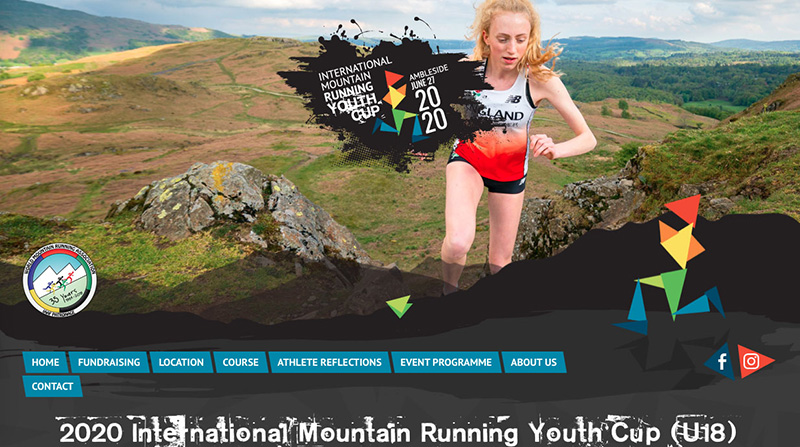
We’re delighted to bring you the news that under 18 athletes will still get the chance to enjoy running in this beautiful location as the local organising committee have managed to secure a new date for the International U18 Mountain Running Cup of 24th July 2021 in order to keep it in Ambleside. They are thrilled to be able to offer this new date and to welcome athletes and their families from all over the world to the historic Lake District, the home of fell running.

This event is so important for young athletes and has helped to nurture so much talent over the years. It has taken a huge amount of work from the local organising committee, under challenging conditions which have been unprecedented, to make it happen. Find more information here: https://www.amblesidemountaincup.com/

The ‘New Normal’ For Mountain Running

As lockdown restrictions have eased in most countries and the mountain running community takes tentative steps to return to competition, we wanted to take a look at what events will look like in the near future. First up, we asked our athletes’ commission what their current experience is of races, virtual challenges and whether they’ve been tempted by attempting any FKTs.

 There is still a lot of variation between countries, and even states in the USA. But in those countries where races are taking place again, the experience of runners is likely to be quite different from ‘normal’ times.


The new normal in racing

In Japan Fujio Miyachi reports that there are many measures being taken to prevent the spread of Covid-19. Examples include: registration and race start times being staggered; not having an awards ceremony; supporters wearing masks at all times and runners wearing masks at all times except when they are running.  

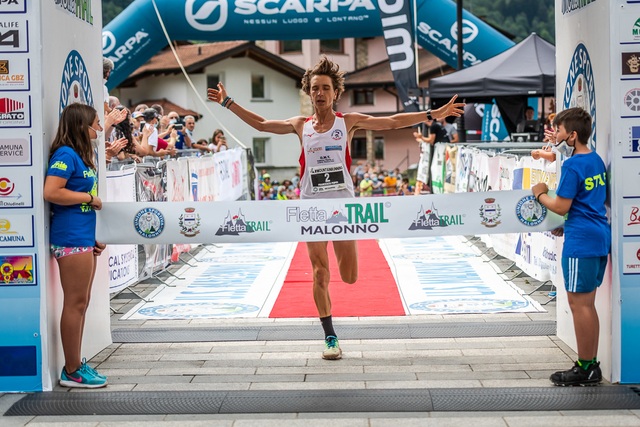
It’s a similar picture in Italy. This was Francesco Puppi’s experience of Fletta Trail at the start of the month: “The first real race was last Sunday’s Fletta Trail. This time we had a normal start (limited to less than 200 athletes), with a separate start for men and women. Athletes were again supposed to wear masks in the start and finish area and to start running with the mask for the first 500m (as established by our federation’s new protocol for road and mountain running races). The start area was organized as a grid, in which athletes were 1.5m apart from each other. It worked quite well and, again, people seemed to be respectful of the new measures.”

50179699231 b80287ba5c o

Francesco wins Fletta Trail 2020

However, as Francesco point out, the measures rely on athletes taking personal responsibility and he stresses that we need to continue to educate runners. “The only problem is that outside the competition area people can do pretty much what they want, and it’s not the organizer’s responsibility to make them respect the rules. So the problem might be just avoided but not really solved. As always, it’s up to each one of us to be respectful towards social distancing measures and towards the others. I think here in Italy people are aware of the risks and the necessity to be careful (because of what we’ve been through during last spring), but not everyone in the same way. So the best approach is to educate people/athletes and give them the information and tools to protect themselves and the other people.”

Another safety measure employed by organisers is to adapt the race into a time trial. Francesco took part in a time trial on the course of Trofeo Ciolo, Puglia (last year’s venue for the Masters World Mountain Running Championships). He describes it as ‘more like an experiment and a symbolic restart for mountain running’ and adds, ‘but it was very meaningful indeed’

“Each participant had to wear a mask in the start and finish area and there was much focus on social distancing measures. Athletes had to start 30” apart from each other and to wear a mask until 5 seconds from the start. There was no prize ceremony and no spectators (officially, apart from the people who were already there..). People were respectful and everything went well, it showed that it is possible to organize such events with a restricted number of people and an established protocol for the competition, even if in a different format from what we are used to”

Kasie Enman, 2011 World Mountain Running Champion from the USA, told us, “there have been very few in person races happening where I live (in Vermont). I heard of one trail race this past weekend that had 4 separate starts throughout the day, allowing no more than 25 people per start. It seemed to go off ok. With the pandemic still in a very uncertain place, and outbreaks happening throughout the US, I have just felt like I should do my part to avoid non-essential races. I did participate in a no-contact track relay that USATF-New England is promoting. Instead of handing off a baton, the incoming runner moves to an outside lane and the outgoing runner starts when their teammate crosses the line. I participated in a 2 person 5 mile relay, alternating every 400m with my husband as my partner. And I also ran the 1 mile leg of a women’s DMR with 3 other members of my local running club. That was a lot of fun, and a good way to get in some speed work.”

 Julien Rancon describes the return to racing in France, “Here in France, a few small races have taken place since the end of July (with a limited number of participants, wearing a mask for collecting the bibs and even at the time of departure and just after the finish, many races are done against the clock or at with starts with very small groups)”.

Virtual racing and fkts

So racing is slowly returning, but with many restrictions to keep the runners safe. But what if athletes aren’t able to race where they live, or they still worry about the risks associated? Well there’s always virtual races and FKTs!

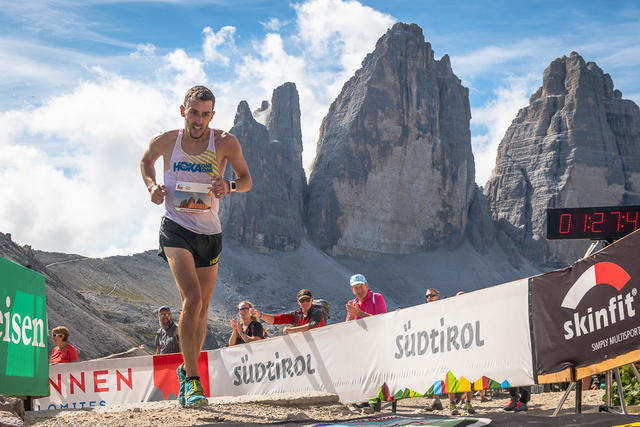
There have been a huge number of virtual race initiatives to give athletes their fix of competition (or just for fun). Andrew Douglas, men’s winner of the World Cup 2019,  has taken part in a couple of virtual events this summer: “a 5km time trial and a hill reps challenge (how much vertical ascent can be gained over 30min, whilst starting and finishing in the same place), both organised by Scottishathletics. Some of the initiatives over the summer have been really innovative and successful. I think placing more emphasis on them being challenges rather than races is what they’re about, and it just adds something different to the everyday training that athletes are trying their best to get on with.”

Andrew Douglas Drei Zinnen 

Andrew Douglas, 2019 men’s World Cup winner

While she hasn’t been motivated by virtual races, Kasie Enman recognises how important they’ve been to some runners. “I have been helping our local running club organize some virtual races in place of the schedule. They have all been very unofficial and focused on just keeping people active and having fun. We have had to be careful about liability, so keeping any events unofficial and at people’s discretion has felt like the best way to go.”

Francesco Puppi took part in what has probably been one of the most high profile virtual races, Kilian Jornet’s marathon relay. Francesco told us “I did one virtual competition after the lockdown (NN Running Team MA RA TH ON) with Kilian Jornet, David Nilsson and Mustapha Mohammed. It was a virtual relay and each one of us had to record a 10.5 km time trial with the GPS to complete the marathon distance. Our team got 4th overall (out of 100000 teams) with a time of 2h08’36” (I ran my leg at 3’05/km pace). It was a nice experience because it really felt like sharing it with all athletes around the world, the community we built was cool. It was also nice to be asked by Kilian to join his team. I am not a fan of virtual events but for this occasion I was happy to join (also it was not an individual event, but a team competition). As there was no entry fee for the event, I decided to make a donation to support SOS Mediterraneè for their invaluable work in the Mediterranean with refugees.”

With few races to enter, many runners have set their sights on some records and FKTs for challenges around the world.  Andrew Douglas has enjoyed seeing some of the big FKTs attempted in Scotland. “Here in Scotland there’s been a few ultra-type FKT’s that have been attempted. For example, just last weekend one of our top hill runners, Sasha Cheplin, set a new record for the most Munros (what we call mountains that are over 3,000ft high) climbed in the space of 24hrs; he managed an incredible 32! For me personally, I’m just focusing on training and trying to stay race-ready in the hope that when any racing opportunities do come up that I’ll be ready to go.”

Kasie Enman isn’t ruling out a local FKT  “I may attempt one on my local mountain, Camel’s Hump, just for fun. There are a few different routes up that I run routinely in training, but I’ve never gone for a hard timed effort. Maybe now is the time!”

Francesco Puppi attempted a spectacular FKT with Cesare Maestri: “I attempted an FKT, running with Cesare Maestri from Madonna di Campiglio to Cima Tosa and back (32km, 2200m D+) in the beautiful Brenta Dolomites (I really suggest you to visit them once in your life). It was not really an FKT because there was no established time to compare with, but we wanted to set a benchmark for this course. The focus was not much on the record and the time (3h28’26”), but on our style. We ran with just mountain running shoes, shorts and top, but no poles, backpack or trail vest for example. We wanted to show that as mountain runners we can run fast on any surface, and the course literally offered any type of terrain, from road to dirt trail, to rocks and snow. The first part was very fast, the higher section (up to 3173m) was really technical, with a 60m wall we had to climb in alpine style, with ropes and harness. It was very challenging for me and also a good performance. The best thing was to run in such a beautiful landscape and to share the experience with Cesare, a long time friend. It was also nice to plan the event (with the support of our sponsor Nike and the local tourist board Campiglio Dolomiti), it was a chance to stay focused on something we both wanted to do despite the lack of competitions. The idea came during the lockdown, when perspectives were very very limited…now the situation is a bit different, fortunately, and we hope it can continue to improve.” 

 See a video of Francesco’s FKT in the Brenta Dolomites: 

So it seems that while races are making a tentative comeback (with many safety measures), athletes will always find a way to adapt and enjoy the mountains, with a bit of competition thrown in.

International U18 Mountain Running Cup Cancelled

Sadly it has been necessary for the International U18 Mountain Running Cup, which was to take place in Ambleside in the UK, to be cancelled. Here’s a statement from the Chair of the local organising committee, Duncan Richards.

“In light of the growing global unpredictability regarding COVID-19, it is with much regret that the Local Organising Committee of the 2020 International Youth Cup have decided to cancel this year’s event.

The safety and wellbeing of all participants, but especially young athletes, is our priority and the travel/transport and accommodation requirements meant pushing ahead would be a gamble. A gamble we cannot afford to take.

We’re extremely grateful to Jonathan and the WMRA committee for their constant support and encouragement. Myself, as event Director would also like to pass on my appreciation of the massive amount of work the Local Organising Committee, from Ambleside AC, have put in over the last two years, as well as sponsors and supporters.

We are looking into the possibility of staging the event in 2021, however this is at a very early stage and due to the complexity and again uncertainty an announcement will be made later on whether this is possible.”

 Duncan Richards

LOC Chair 2020 International Youth Cup

FLETTA TRAIL: Francesco Puppi and Elisa Sortini Crowned Winners

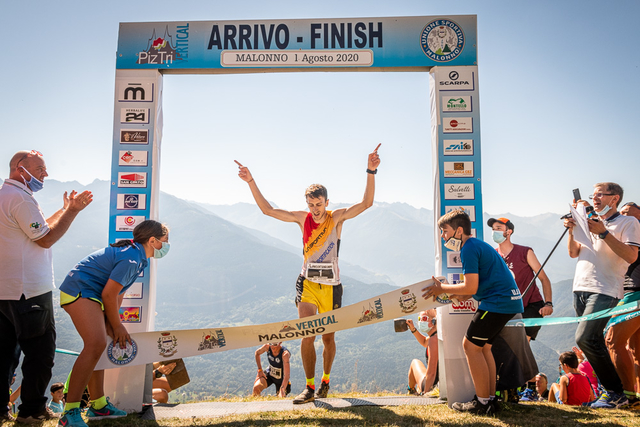
After a hot and sunny PizTriVertikal it was a cloudy day in Malonno for Fletta Trail, one of our associate races. The kind conditions helped athletes to run fast times along the mountains of the Valcamonica.

 A dramatic sprint finish in the men’s race saw Francesco Puppi (Ita) able to catch Sylvain Cachard (Fra) in the last 200m after leading throughout the second part of race. It took a huge effort from Puppi to reverse a competition he almost lost.

Puppi and Cachard gave a big kick from the start with help of Maestri who soon lost contact with the leaders. On a tough uphill in the middle Puppi pushed hard but Cachard calmly kept control and changed pace on the downhill. The drama unfolded in the last kilometre, with the French athlete tiring and powerless to do anything when the strong Italian caught him. Puppi was the men’s winner of Fletta Trail 2020 in 1h26.27 just in front of Cachard, second in 1h26.41 while third was last year’s champ Cesare Maestri in 1h28.42. In fourth place was former European champ Martin DeMatteis with Irishman Zak Hanna completing the top 5.

50179699231 b80287ba5c o

Puppi was thrilled about his race saying, “This is the race of mountain running and winning here is very exciting. Against Cachard it was a hard battle and real fight. I’m happy to be back racing after a difficult period with Covid where my team had problems.”

Starting some minutes earlier the women’s race belonged to Elisa Sortini who, firstly with Lorenza Giudici (Ita) and Alice Gaggi (Ita), and then alone, took the lead and ran away for an outstanding solo victory after a superb race.

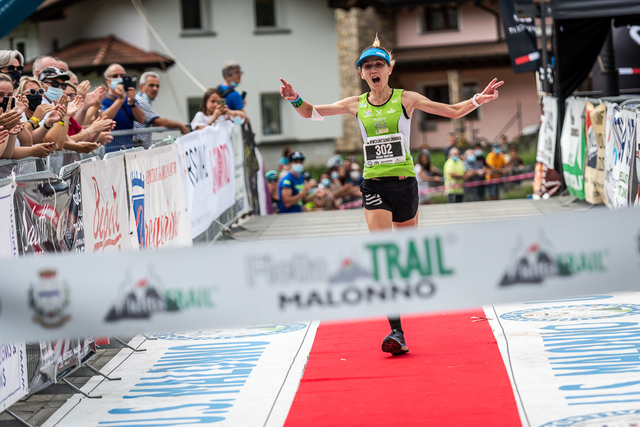
Elisa Sortini ran the third best time ever on the Fletta Trail course and said afterwards: “I am very satisfied with today. I was not sure about my shape after such a long break. Training every day without competitions is not the same. I wasn’t thinking about such a result on such a fast course but anyway, I did it. Let me thank the organizers for a great day and giving us the chance to compete for the first time this season.”

50179699316 db1b1e03d6 o

Sortini’s time was 1h41.38, with Lorenza Beccaria (Ita) in second place in 1h43.55 and Erica Ghelfi (Ita) third in 1h44.17 after also competing yesterday in PizTriVertical. Mojca Koligar (Slo) was fourth in 1h45.53 and Alice Gaggi fifth in 1h47.41.

The organizers did an excellent job keeping all the athletes safe with social distancing and with the use of face masks for spectators and athletes (in the first 500m of the race).

 Full results 

PizTriVertikal: Andrea Mayr Is Back!

Today saw a hugely exciting competition in Malonno with “PizTriVertikal”, the very tough vertical race, which finally opened a difficult and complicated season for mountain running.

Andrea Mayr (Aut) confirmed once more her legendary supremacy in mountain running with an impressive solo performance, winning the women’s race (for the third time) in 38.35. Andrea was really happy after the race to have competed in Italy:” It was a very difficult period for me due to covid-19 and an injury but finally I am back. When I heard Malonno would be held anyway, I was so happy to come again to this unbelievable place. It is always exciting to compete here with all local supporters cheeering you along all course”.

Malonno reacted in an exemplary way way to the pandemic with appropriate social distancing and masks, demostrating once again why it’s the home of mountain running.

A long distance behind Mayr, Erica Ghelfi (Ita) closed second position in 41.22 and Mojica Koligar (Slo) completed the podium in 42.54. Ilaria Veronese (Ita) was fourth and Maria Dimitra Theocharis (Ita) fifth.

There was a massive duel in the men’s race between defending champion Henry Aymonod (Ita) and rising off-road star Davide Magnini (Ita) with Aymonod emerging the winner in a stellar 34.10, the second fastest ever on the course and only one second off the course record. Magnini got second place in 35.01 despite a not having a perfect day.

50176124327 4ed82c7ae8 o

Real fighters in the men’s race included Zak Hanna (Irl) , who was third in 35.14, and Sylvain Chachard (Fra ) who ran 35.23, ahead of M.DeMatteis (Ita) in 35.27 to complete a fantastic top 5.

Very happy with his victory Aymonod said: “Yesterday my coach told me to play my cards well and so I did it. Started a little bit slow and, after halfway, gave a kick and start pushing. Really satisfied. With some more contenders, I am sure today we could have broken the current record. Next time”.

Full women’s results

Full men’s results

image00091

With Thanks from K42 Argentina and Smarna Gora

 Our public vote to find your greatest mountain race of all time concluded this week, with Smarna Gora crowned winner, beating the race you voted long distance champion, K42 Argentina. We hope that our contest, while just for fun, has helped to celebrate the many incredible mountain races which exist in the world. All different, all unique in their own way.

Our finalists, K42 Argentina and Smarna Gora, were blown away by your support and both wanted to say something to the voters and to the other races which were in the contest. Here are their kind words.

Firstly, from the runner-up, K42 Argentina:

Dear Organizers,

Public voting put us in the final of the Greatest Race of All Time and we feel really happy about that!

I know perfectly well that this is the result of the passion of our audience and does not necessarily represent an objective comparison that makes us better than the rest of those who have participated in this fantastic WMRA initiative, therefore, and we try to accept it with the greatest humility and respect. Therefore, we try to accept it we the upmost respect and humbleness.

I want to express to you that, myself and the rest of our team, have been inspired by you during all these years. We have tried to take the best of each race; we have admired the excellence of all of you and we will continue doing it beyond this circumstance.

We send you a warm hug from Argentinian Patagonia and we hope that this contest unites our interests and projects to continue growing together!

Diego Zarba, K42

49067342398 9400bab205 o

And from Smarna Gora:

Dear Mountain Running friends,

Public voting is a strange thing. It is like a wild river, unpredictable, unmanageable.

And in this game of the votes Smarna gora has shown its true nature, that has been developed during the four decades of the race.

We are completely aware that Smarna gora cannot be compared to the beautiful scenery of the Drei Zinnen or Grossglockner, to the extremes of Sierre Zinal, to the mass participation of some other races, or to the budget of the others.

Smarna gora is not even a mountain, with 669m it is just a hill, the trails are narrow and space on the summit is very limited, so we can simply not organize a mass event. But it is the most visited peak in Slovenia, in a county where mountaineering and hiking and recently mountain running are a kind of national sport.

After 40 years of the race and after hosting 18 years the World Cup final and 25 years of the Slovenian Cup final, we were determined to fight for the first ever title “the greatest”. We have activated hundreds of fans of mountain running and Smarna gora in Slovenia and abroad.

And we were successful.

We know that our race is not “the best” on the world, simply because the criteria for this are not defined. We are just the winners of the WMRA contest for the “greatest mountain race all times”.

Finally, on behalf of the Smarna gora team, I would like to thanks all the people, who participated in this “voting game”, of course especially to the ones, who supported our race in all four circles of voting.

I would also like to congratulate all the race contenders; I’m sure any of those 24 races would deserve to be a winner.

Tomo Šarf, on behalf of the Smarna gora team

48882497396 d3de385027 o

And The Winner Is…

Over the past few weeks thousands of you have voted for your favourite mountain races in our quest to find your ‘greatest mountain race of all time’. We can now exclusively reveal that the race you chose as your winner is … Smarna Gora!

Smarna Gora in Slovenia proved a highly popular race at all stages of the competition. Its long history, the calibre of runners it has attracted over the years, its welcoming atmosphere and the fact that it remains close to its roots as a pure, unspoilt mountain race all contributed to its popularity. Congratulations Smarna Gora!

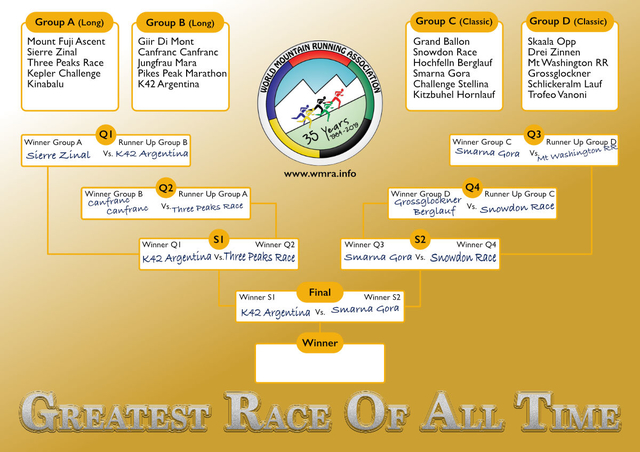
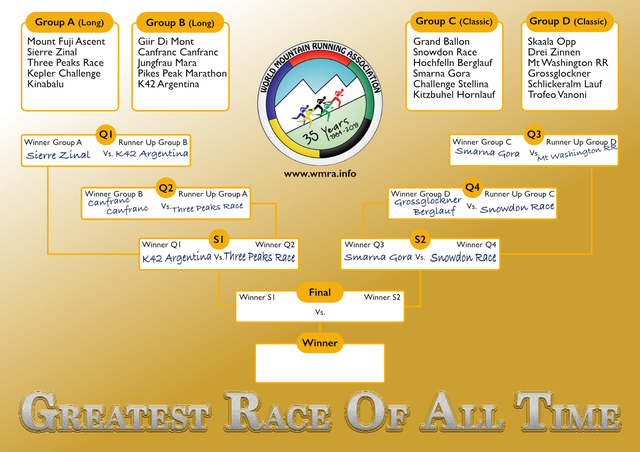
So how did we get down to our winner? We started off with 10 long distance races and 12 classic distance races. These were:

Long distance: Mount Fuji Ascent, Sierre Zinal, Three Peaks Race, Kepler Challenge 60k, Mount Kinabalu International Climbathon, Giir Di Mont, Canfranc Canfranc, Jungfrau Marathon, Pikes Peak Marathon, K42 Argentina.

Classic distance: La Montee Grand Ballon, Snowdon International, Hochfelln Berglauf, Smarna Gora, Challenge Stellin, Kitzbuhel Hornlauf, Skala Opp, Drei Zinnen, Mount Washington Road Race, Grossglockner Berglauf, Schlickeralm Lauf, Trofeo Vanoni.

You voted for your favourite races amongst this original list and the most popular 4 from each group went through to the quarter final stage. These were: Sierre Zinal, K42 Argentina, Canfranc Canfranc and Three Peaks Race from the long distance races and Smarna Gora, Mount Washington Road Race, Grossglockner Berglauf and Snowdon International from the classic distance.

GROAT F

The races now went head-to-head and this gave us semi finals of K42 Argentina vs Three Peaks Race and Smarna Gora vs Snowdon. This decided your favourite long distance race, which was K42 Argentina, and your favourite classic race, which was of course Smarna Gora.

So thank you to the thousands of you who voted. We hope that you’ve enjoyed a bit of competition in a year when it’s lacking. We will be bringing you interviews with the K42 Argentina and Smarna Gora race directors in the next few days.

The Final of Greatest Mountain Race of All Time

It’s time for the final of our ‘greatest mountain races of all time’ contest. Over the last couple of weeks you’ve been voting for your favourite long distance and classic distance mountain races and now we’re down to our final two races: K42 Argentina and Smarna Gora (Slovenia).

 There have been some shocks along the way. Skåla Opp, a firm favourite with the athletes we spoke to, didn’t progress beyond the first stage. Sierre Zinal, who many predicted would be the eventual winner, fell at the quarter final stage. But the mountain running community from all over the world have voted and now there will be one final vote, between the events you have voted the greatest long distance race and the greatest classic distance race, to decide the over all winner. Vote using the form below! Voting closes on 9th July.


Semi Final Voting is Now Open!

Thank you for all your votes so far in our greatest mountain race of all time contest! We are doing this primarily to remind you of all the great races in the world, many of which we will be missing this year. If we can’t do the races we can at least celebrate them, their history, their stunning courses and the atmospheres that bring runners back to them year after year.

 If you’d like a reminder of all the races that we’ve been celebrating in this contest, here it is. Hopefully it will give you some inspiration for future years of running.

We can now announce that the semi-finals for our greatest mountain races of all time will be:

K42 Argentina vs Three Peaks Race

Smarna Gora vs International Snowdon Race

Voting is now open via the form below! It closes at midnight CET on 4th July