WORLD MOUNTAIN RUNNING ASSOCIATION

Author: Tomo Sarf

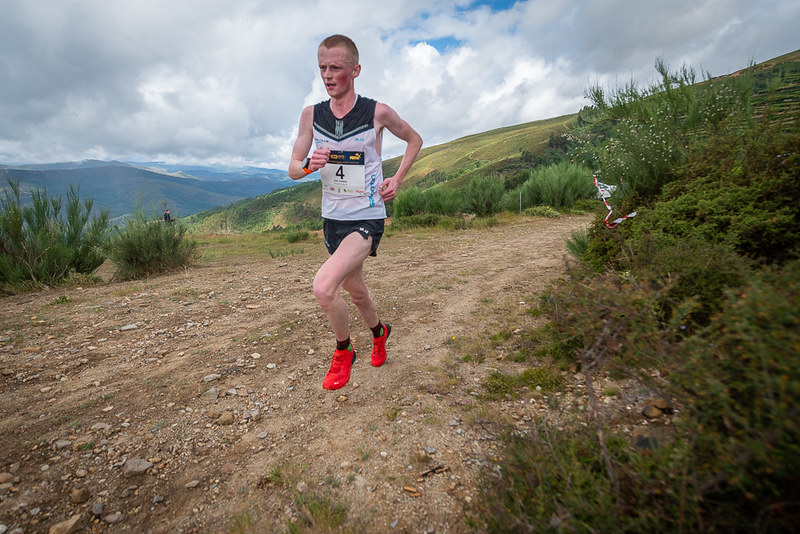
Adkin and Ricard Triumph at Montemuro Vertical Run

An exciting day of racing in hot conditions in Castro Daire brings a win for Scout Adkin and a Canadian 1-2 in the men’s race with Alexandre Ricard and Remi Leroux.

After a successful first inclusion in the Valsir Mountain Running World Cup in 2022 we headed back to Montemuro Vertical Run for another taste of Castro Daire and the region’s passion for mountain sports.

The weather was hot, with temperatures around 27 degrees centigrade at the start line, and with very little shade along the course and the relentless profile of it, it was going to be a tough race for some. Our third Gold Label event of the 2023 Valsir Mountain Running World Cup had attracted a very international field with 14 countries represented, including Kenya, Canada and New Zealand.  Last year’s women’s winner, Joyce Njeru, was back, as was Zak Hanna, who finished second in the men’s race. Both fields were stacked with international and home talent.
Montemuro profile
The course

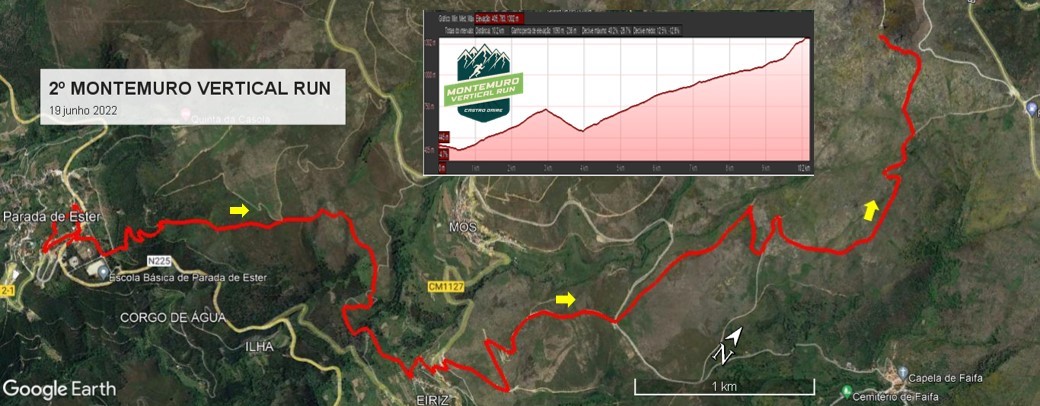
Runners took on a course of 10.4km with 1090m of ascent, with a 100m descent a third of the way in. After a fast and furious net downhill loop around the streets of Parada de Ester, athletes then began the long climb up to 3km, before dropping down again for a kilometre, then climbing steadily again to the finish, with one final, steep kick up to the summit.

Women’s race

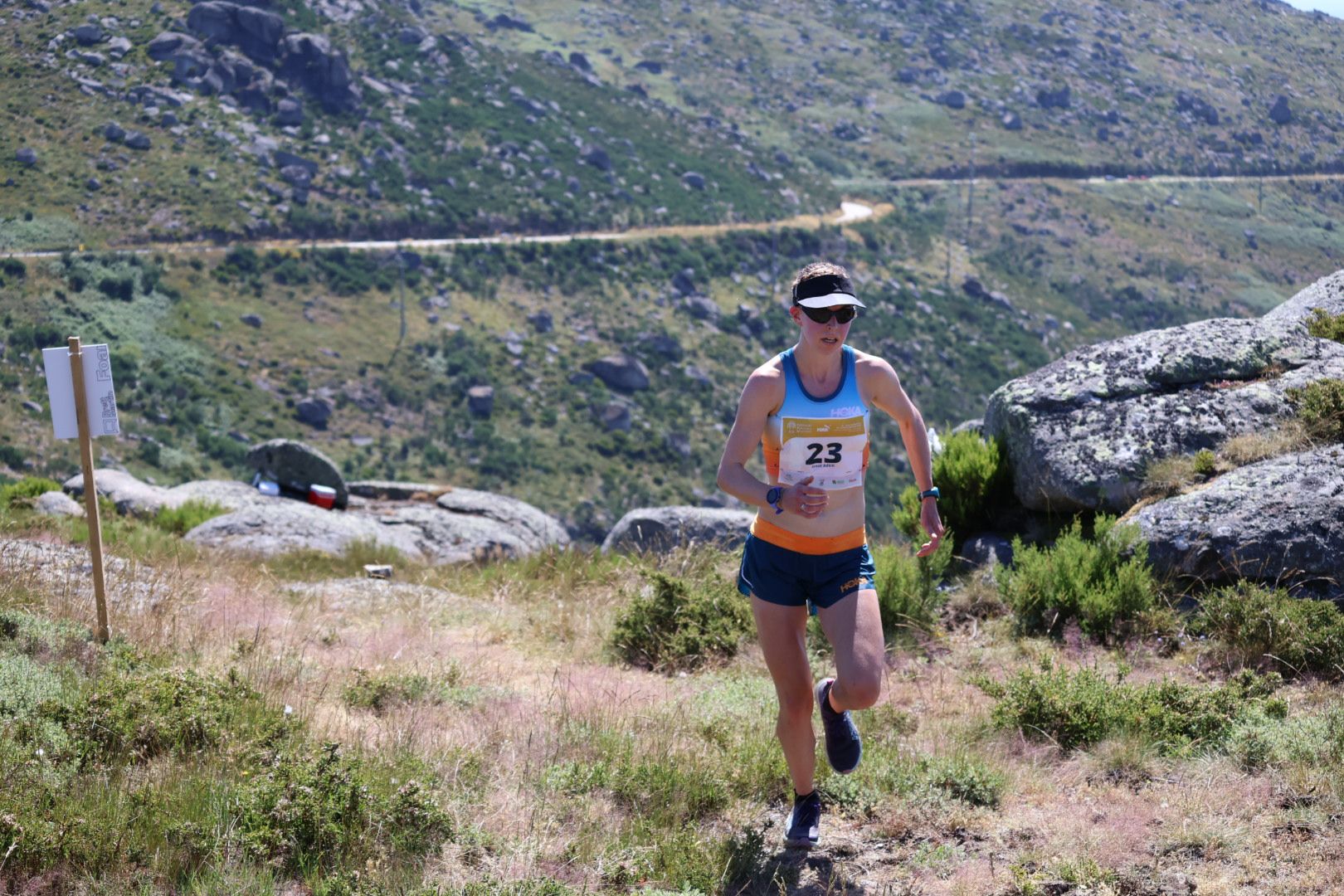
The women set off first and after the lap around town it was Joyce Njeru (KEN), Scout Adkin (GBR) and Camilla Magliano (ITA) who led the pack up the first climb, closely pursued by a big group. After emerging at the first timing point at 5km it was Njeru who had managed to pull away. She recorded a split of 26.58 here, and Adkin was just over a minute behind. By this point it was Lucy Wambui (KEN) who emerged in third place, a minute behind Adkin, and then a big gap of two minutes had opened up to Magliano.

Adkin 2 credit Marco GulbertiNjeru was looking very strong as ever, so it was no surprise to see her hitting the 8km point first, but Adkin had actually managed to close the gap slightly as she was now just 50 seconds behind. Would she be able to claw back that time in the final few kilometres? Adkin had by this point pulled further clear of Wambui, who was now over two minutes behind, with Magliano almost three minutes behind her.

Incredibly, by the time the runners emerged onto the final section leading up to the summit Adkin had not only closed that 50 second gap but she had overtaken and opened a two minute gap within the space of just over two kilometres. Adkin took the win in 1.04.08, with Njeru coming in second in 1.06.20. Wambui held onto third, finishing in 1.09.13. Magliano took fourth in 1.12.17 with fellow Italian athlete Madallena Soma in fifth in 1.14.30.

Men’s race

The men set off 10 minutes after the women and after the lap of town it was Michael Sutton (NZL) was led up the climb, but they were still closely packed together. And by the 5km timing point it was still all very close indeed. Alexandre Ricard (CAN), Alex Baldacini (ITA) and Rui Teixeira (POR) were all together, with a split of 24.29 (and a second between each). From them there was a gap of 17 seconds to fourth place (Remi Leroux, the other Canadian runner) and 28 seconds to fifth (Alric Petit of France). With a minute separating the first seven runners in the men’s race it was all to play for.

At the 8km split the gaps were starting to open, but not by much. Ricard had now opened a gap of 40 seconds to Leroux, and Baldacini was 10 seconds behind Leroux. Could we beRicard credit Marco Gulberti about to see a Canadian 1–2 at a European Mountain Running race? Baldacini wasn’t going to let that happen without a fight, and Teixeira and Petit were still hot on their heels too.

As the men emerged onto the final section Ricard had successfully held onto his lead and stretched it out a little. He won in 54.54 and Leroux did indeed make it a Canadian 1- 2 by taking second in 56.07. Baldacini hung onto third, completing the podium in 57.26. Petit succeeded in opening a small gap on Teixeira, to finish in 59.02, 14 seconds ahead of Teixeira.

Full results for the race can be found here. 

World Cup standings

How does Montemuro affect the overall World Cup standings? His win here will place Ricard in equal top spot of the men’s classification, along with Henri Aymonod, Eli Hemming and Andrea Rostan. Adkin’s win will put her in equal second of the women’s classification, along with Allie McLaughlin and Sara Willhoit. Anna Gibson remains at the top spot for the women.

Next World Cup races

Next up for the 2023 World Cup we’ve got a double header in Malonno! On 15th July runners will take on Piz Tri Vertical, our next vertical uphill race, then the following day it’s Fletta Trail, a classic mountain race. Find information about both races here.

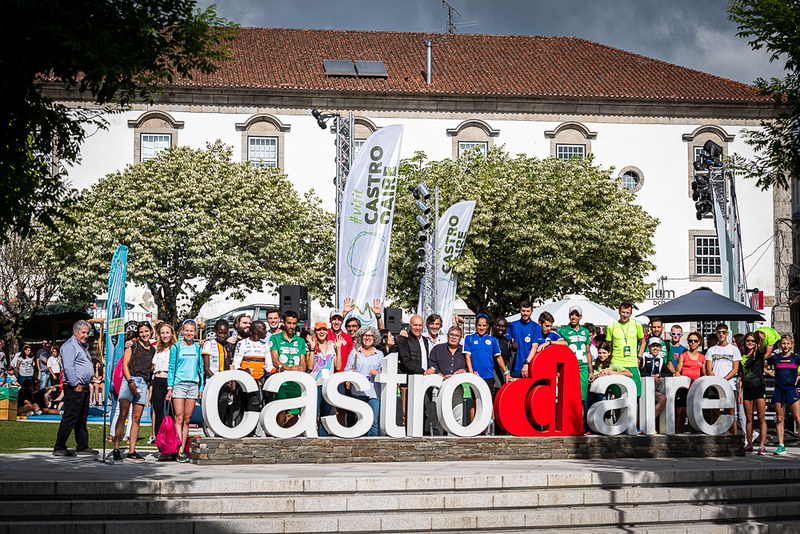
The World Cup Heads to Portugal for Montemuro Vertical Run

The next Gold Label event in this year’s Valsir Mountain Running World Cup takes place on Sunday 2nd July in Castro Daire, Portugal, and it’s a classic mountain race. 

The second Gold Label race of this year’s Valsir Mountain Running World Cup will take place on the 2nd of July at the Montemuro Vertical Run in the municipality of Castro Daire, Portugal. It’s just the third edition of this race and its second inclusion in the World Cup, but it has already revealed itself to be a classic in the making.

Our first World Cup visit to Castro Daire was in 2022 and it was also the World Cup’s first visit to Portugal. The course and the race didn’t disappoint and it was a Kenyan double for Joyce Njeru and Patrick Kipngeno. Unfortunately Kipngeno will not return this year, but Njeru will, off the back of a successful World Championships. Let’s take a look at the race and who we can expect to see on the start line this year.

52156122433 a3bc4c1478 cThe region of Castro Daire is developing something of a reputation for mountain sports, having worked hard to develop its potential for running and cycling in recent years. There is a local circuit of 8 mountain running races and the Montemuro Vertical Run has hosted the Portuguese mountain running championships for the last two years. 
The Montemuro Vertical Run starts at 434m in Parada de Ester, just above the Paiva River. The opening kilometre takes the runners through the streets before they turn left, heading north toward the summit of Montemuro. This where the climbing really begins in earnest and athletes get little or no respite as it goes on more or less continuously to the finish, after a cruelly steep final climb, at 1,317m.

All in all it is 10.2km, 980m+ and 106m-, putting the race in the Classic Mountain category. A lot of the course is on decent paths and runnable, with some downhill sections where decisive moves could be made. Last year’s event showed that it is a course where we will see some fast racing.52157562976 27d3ae8a0d c

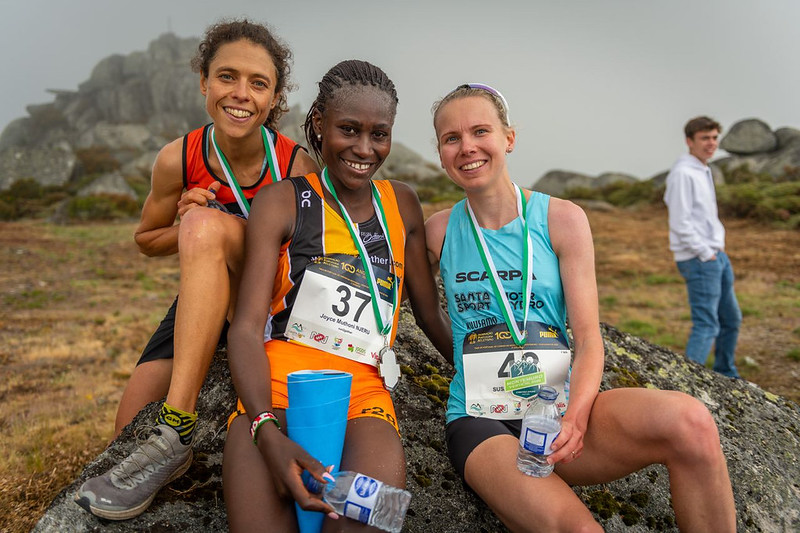
Joyce Njeru (KEN) will be back as the returning champion and, after her third placed finish in the recent classic race at the World Mountain and Trail Running Championships, she could be hard to beat. The whole of last year’s women’s podium will be back again this year, with Susanna Saapunki (FIN) and Camilla Magliano (ITA) both returning too.

But they will face even more competition this year if they want to get on the podium again. Scout Adkin (GBR), fresh from achieving 8th place in the uphill race and 12th in the classic race at the World Championships, will be expected to feature. Lucy Wambui (KEN) is always one to watch, and she will toe the line alongside Charlotte Cotton (BEL), who was 9th here last year, as well as a whole host of strong Portuguese athletes, including Joana Soares, 6th last year and the course record holder.

52158790560 9ac4ef1d66 cKipngeno may not be there, but the second placed male runner from 2022 will. Zak Hanna (IRL) was 4th at the Broken Arrow Vertical Race two weeks ago and will be a strong contender again here. But he will face competition from a highly international men’s field.
Marek Chrascina (CZE), last year’s 4th place finisher and the 2019 bronze medallist at the World Championships, will return. Raul Criado (ESP) is fast becoming a familiar name in World Cup races and he will arrive in Castro Daire on the back of two 11th place finishes at Broken Arrow. Alex Baldaccini (ITA) is another big name on the start list, having been our 2017 men’s World Cup overall winner. Alexandre Ricard and Remi Leroux of Canada, Pablo Camescasse (ESP), Alric Petit (FRA), a group of young British athletes including Matthew Knowles, and a host of strong local athletes will make it an interesting World Cup battle.

We may even see some exciting new talent emerging in both the men’s and women’s races, just as we did at Broken Arrow.

The women’s race will start at 10am on Sunday, followed by the men’s race at 10.10am. We look forward to bringing you the action as it happens via our social media channels.

McLaughlin and Hemming Win Exceptional Broken Arrow Skyrace 23k

Extreme weather conditions lead to changes in the 23km Broken Arrow Skyrace course, making it a two-lap route but it served to make the racing more exciting than ever. 

The vertical uphill race at Broken Arrow on Friday was made even more challenging this year by the record snowfall in Lake Tahoe, but how would it affect the 23k Broken Arrow Skyrace? This race was to provide our second Gold Label event and first long mountain race of this year’s Valsir Mountain Running World Cup.

The conditions were sunny and cool (9 centigrade/48 fahrenheit) for the start, but the biggest issue for the runners wasn’t the snow, it was the wind. The route usually consists of a single loop with 1,533m (5,033 feet) of climbing, topping out at Washeshu Peak. However, the organisers made the decision that the high winds (gusting up to 70mph on the summit) constituted a safety risk for the runners, stating that ‘runner safety will always be our primary concern and today’s conditions leave us no other viable options’ and had to modify the course. The start time was also delayed by 90 minutes to 9.30am.

The route would now be two laps totalling approximately 22km (13 miles) with approximately 1370m (4,500 feet) of ascent. The new route would avoid the exposed ridges and the famous ‘stairway to heaven’ ladder, which would pose a serious safety risk. The amended route still had large parts that were under snow, so it would still be very challenging underfoot. However, as it was slightly shorter with slightly less ascent, we were expecting faster than usual times.

Both the men’s and women’s fields boasted big names. Although she pulled out of the vertical uphill race it was announced on Sunday morning that Allie McLaughlin (USA) would be taking part in today’s race. She was second here in the 23k in 2022. Alongside her would be Anna Gibson (USA), the winner of the vertical uphill race on Friday, Sara Willhoit (GBR), third on Friday and other strong runners such as Janelle Lincks (USA), the 2021 winner here, and Rachel Drake (USA).

In the men’s race the winner of the vertical uphill race, Andrea Rostan (ITA), was also back, as was third placed Henri Aymonod (ITA), fourth placed Zak Hanna (IRL) and fifthBeaudoin credit Andy Wacker placed (MEX). Zak’s fellow Irishman Paddy O’Leary, Eli Hemming (USA), Chad Hall (USA) and Liam Meirow (USA) were also expected to feature.

Initially in the men’s race it was Hemming and Hall who made a break at the start. They were soon joined by Meikael Beaudoin-Rousseau (USA) The three of them started to open up a lead from the chasing pack through the first lap and it was Hemming in front, then Beaudoin-Rousseau, then Hall at the highest point, with just a few seconds between each.

For the women it was Gibson and Tabor Hemming (USA) who led it out from the front, but within a few minutes they were both passed by McLaughlin. Lincks was just behind them in fourth. Gibson and Hemming remained together for a while on the first climb, but Gibson pulled away a little and by the time they hit the highest point it looked as if she was closing a little on McLaughlin. But it was still a significant gap.

The revised two lap format essentially created a 5k uphill (with a few flatter sections and slight downhills) up to KT22, followed by 5k of downhill twice. Would it be the stronger ascenders who opened up insurmountable gaps, or would it all be decided on the fast downhills? Would the snow be a factor on those downhills? One thing was for sure – having the runners blast through the village at the halfway point was a real highlight for the spectators.

Coming into the finish of the first lap Hall, a 2.14 marathon runner (and Ryan Hall’s younger brother) took the men’s lead once they got off the snow and onto the road.  Hemming was a few seconds behind and Beaudoin-Rousseau a few seconds behind him. Behind them were Aymonod (around 2 minutes behind) and Talon Hull (USA) a few seconds behind him. Patrick Parsel (USA) Hernandez, Rostan, Raul Criado Sanchez (ESP) and Hanna were all within a minute of fourth place.

Allie Mac 2 credit Peter MaksimowMcLaughlin had hammered the downhill and came into the village with a lead of 1.40 over Gibson. Hemming was another minute behind and Lincks was just a few seconds behind her. Another minute back was Willhoit. It was slightly more spread out than the men’s top 10 but after the first lap the other runners making up the women’s leaders were Annie Dube (USA) , Rachel Mow (USA), Gabrielle Orie (USA), Sarah Guhl (USA) and Andie Cornish (USA).

On the men’s second lap Hemming took the lead again and tried to open a gap again on the uphill, having seen how fast Hall was on the downhill. But there was still only 20 seconds between the top three men at this point. But Hemming continued to press on the uphill and started to open a gap on Hall of 90 seconds by the next timing point. Beaudoin-Rousseau was another 30 seconds back. It was all going to come down to the final descent on what was increasingly slushy snow.

Despite her lead McLaughlin didn’t let up at all on the second lap. Gibson continued to chase hard and we knew what a strong climber she was in the vertical uphill on Friday. It was no surprise to see McLaughlin hit the timing point at the highest point of the course first, but the main question was how far behind was Gibson? McLaughlin had maintained a lead of just over 2 minutes at this point. Hemming was still in third place but 3 minutes behind her, with Lincks another minute behind and Willhoit seemingly out of contention for the podium now at a further 2.30 behind. McLaughlin’s victory was starting to look secure, but second and third would be interesting.Taylor Hemming win credit Peter Maksimow

Hemming was able to hold off Hall to take the win for the men in 1.34.46 (Hall in 1.37.13). At just 23 years of age Beaudoin-Rousseau took third in 1.38.33. Hull overtook Aymonod to take fourth in 1.40.27 (Aymonod 1.40.57). 18 year old Ali Papillon finished in seventh in 1.41.33, showing that he will be an exciting name to watch in the future.

Allie Mac credit Peter MaksimowMcLaughlin took a few slides and tumbles on the snow on the final descent but the smile never left her face and she won in 1.51.46. Gibson struggled on the slushy snow, which served to show what a masterful downhill running display it was from McLaughlin, and took second in 1.57.50. Hemming was third in 1.58.55, Lincks fourth in 2.01.33 and Willhoit fifth in 2.03.33.
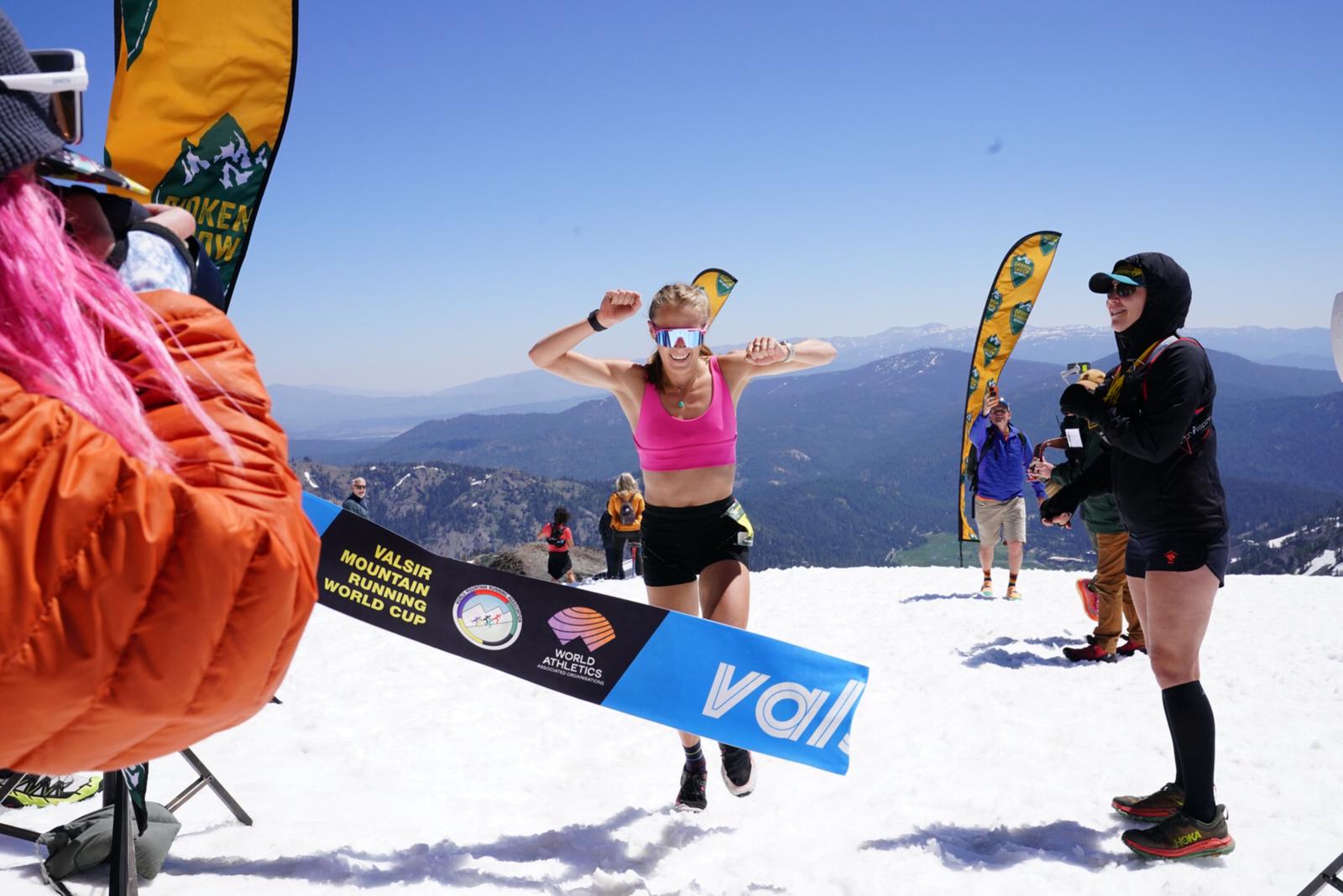
It was an exciting weekend to start off this year’s Valsir World Cup and in just two weeks we will have our next Gold Label race at Montemuro Vertical Run in Portugal.

Full results can be found at: Broken Arrow Skyrace: 23K Results (athlinks.com)


Broken Arrow Launches 2023 Valsir Mountain Running World Cup

The first race of the 2023 Valsir Mountain Running World Cup sees international podiums and historic snow conditions.

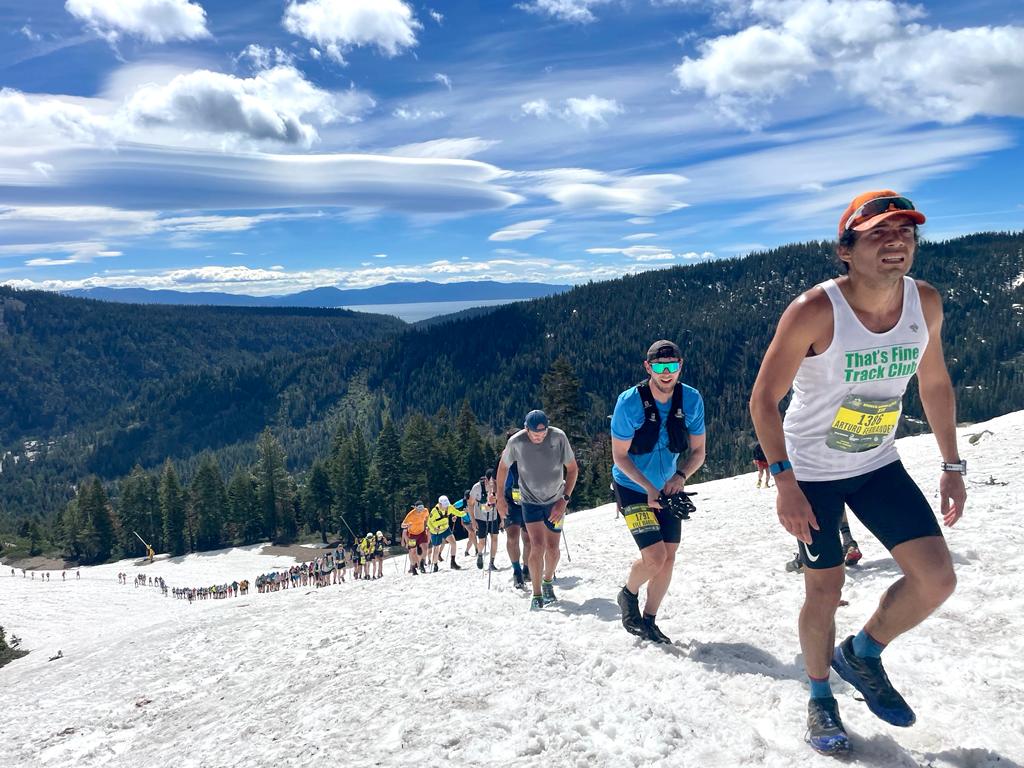
It was already a historic edition of Broken Arrow due to the record breaking snowfall in Lake Tahoe, but it didn’t disappoint on the racing front either. Runners had to contend with long snowfields, with patches of dirt trail in between them, which presented a very challenging course.

The day couldn’t have been more perfect, with clear blue skies and a temperature of around 9 celsius on the start line. However, up at the summit of Washeshu Peak (2,700m) it was a different story with gusting winds, making things difficult for drone operators.

start credit robbie brittonThe vertical uphill race was our first Gold Label race in the 2023 Valsir Mountain Running World Cup, some exciting fields were assembled and anticipation was high. There were some high profile withdrawals before the race, most notably Allie McLaughlin (USA) and Grayson Murphy (USA), who both raced in the World Mountain and Trail Running Championships last week, but there were still very deep fields in both the men’s and women’s race.  

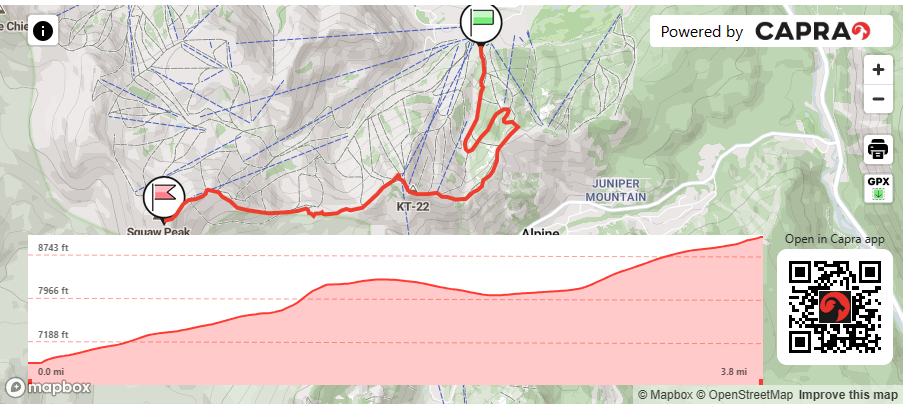
The course itself starts on the valley floor and climbs its way up 954m (3,100 feet) over 6.8km (4.5 miles) to the summit of Washeshu Peak at 2708m (8885 feet). Along the way it takes in some brutally steep terrain, leading up to the Headwall Ridge and the ‘stairway to heaven’ bolted ladder to the summit of Washeshu Peak. Ater the KT22 summit at around halfway there is a slight respite in the form of a downhill section, where the runners can either recover a little, or just push even harder and try to open a gap.

Right from the start of the men’s race there was one runner determined to lay down the gauntlet and that was Andrea Rostan (ITA). There were a number of international runners in the men’s race, who all seemed determined to make their journey worthwhile. Henri Aymonod (ITA) and Zak Hanna (IRL) chased Rostan hard, along with Darren Thomas (USA), the 2021 champion from the vertical uphill race.

In the women’s race there was also a runner who struck out early on and that was Anna Gibson (USA), an athlete who’s achieved track success as well as showing her strength in the mountains by finishing 5th at the 2021 USATF Mountain Running Championships and winning The Rut vertical race.

Behind Gibson there was a group of women who were attempting to stay in touch with her. This included Jade Belzberg (USA), who finished 5th here in 2022, Sara Willhoit (GBR),Andrea Rostan credit peter maksimow fresh from the World Mountain and Trail Running Championships, Amanda Basham (USA) and Nicole Mericle (USA). It was all to play for in the race for second and third, but could Gibson be caught?

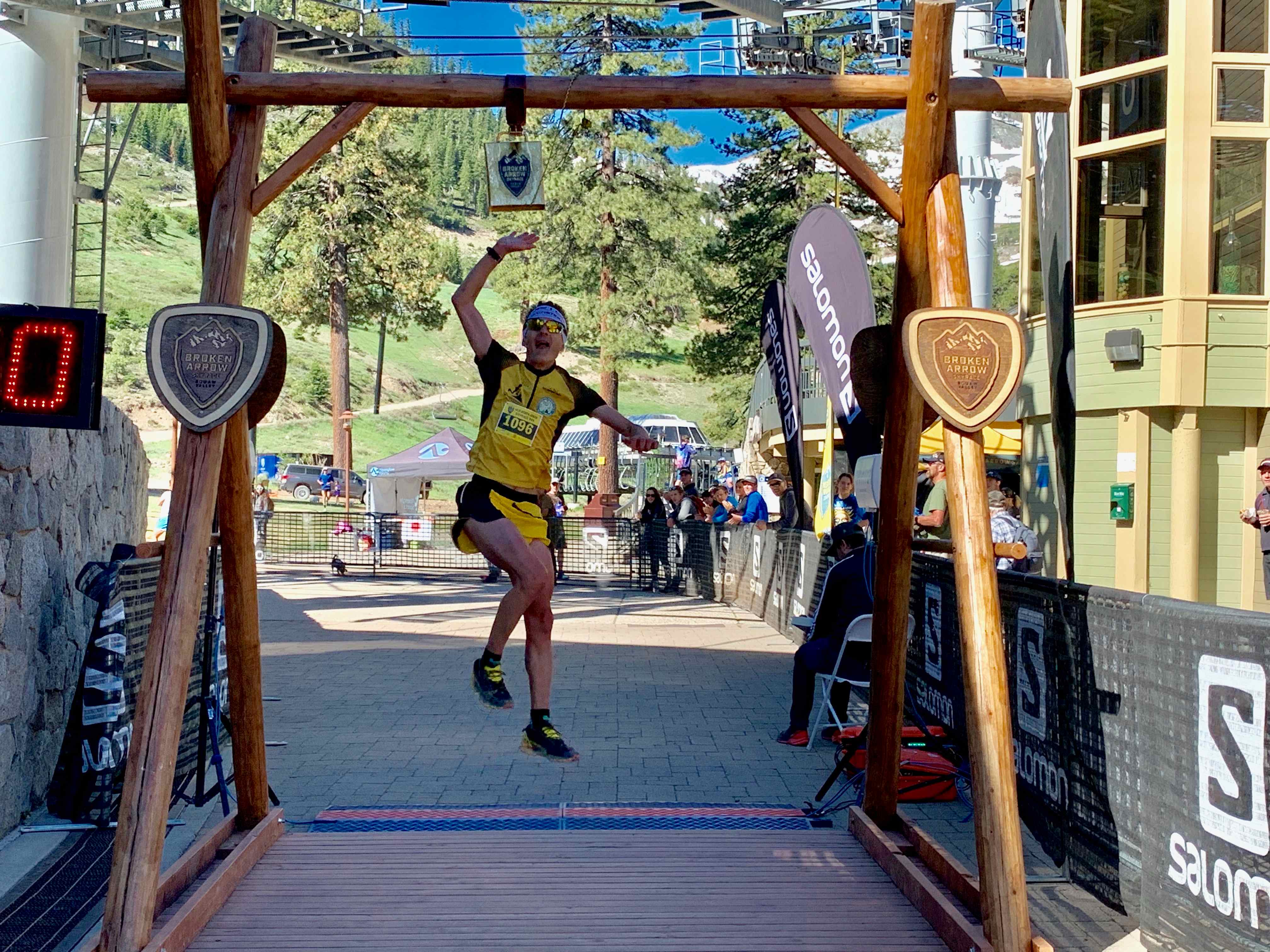
At the halfway point where the runners hit the downhill section after KT22 Rostan was still out in front, showing no signs of fading. Aymonod and Thomas were by this point together and changing positions, with Hanna just behind. Rostan had opened up a lead of 80 seconds and although Aymonod and Thomas were just starting to draw him in a little, there just wasn’t enough distance left to really make a difference. Rostan emerged at the stairway to heaven ladder first and took the win in a fast 39.51. Thomas pulled away from Aymonod a little on the final climb and he finished second in 41.10, with Aymonod just behind in 41.29.

womens podium credit peter maksimowIn the women’s race Gibson stretched her lead out to 2 minutes by the halfway point and, although anything could happen once they hit the final climb, she just looked so strong that it was looking unlikely. But it was all shaking out in the chasing group. By now Belzberg and Willhoit had pulled away from the others in the group and it was looking like a battle for second and third. Gibson couldn’t be caught and she won in 47.09. Belzberg won the duel with Willhoit and they did in fact claw some time back on Gibson, with Belzberg finishing in 48.00 and Willhoit 48.25.
It was an exciting first race to start off this year’s Valsir World Cup and we only have to wait one more day before our next race, the 23k Broken Arrow Skyrace on Sunday 18th.

Broken Arrow Kicks off the 2023 Valsir Mountain Running World Cup

As we gear up for the launch of our 2023 Valsir Mountain Running World Cup we bring you a preview of the first Gold Label Races which get the show on the road – the Broken Arrow vertical uphill race and the Broken Arrow Skyrace long mountain race.

Broken Arrow has been part of our World Cup before, first in 2019, then again in 2021, but it promises to provide even more competitive races this year, with top elite fields. And while it takes place in the US, the event very much has its roots in the traditions of European mountain running, with steep terrain, scrambling and huge amounts of vertical gain and loss at altitude.

The courses

First up is the vertical uphill race on Friday 16th June at 10am (UTC -7). The race starts on the valley floor and climbs its way up 954m (3,100 feet) over 6.8km (4.5 miles) to the summit of Washeshu Peak at 2708m (8885 feet). Along the way it takes in some brutally steep terrain, leading up to the Headwall Ridge and the ‘stairway to heaven’ bolted ladder to the summit of Washeshu Peak.

BA uphill

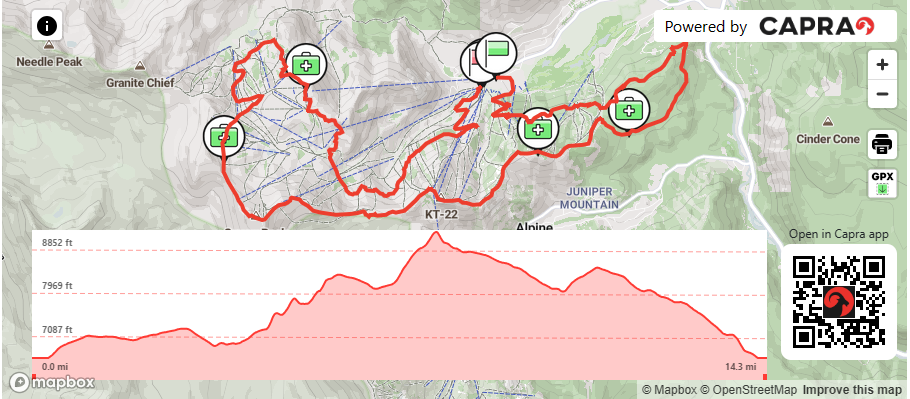
On Sunday 18th June at 8am the long mountain race, the Broken Arrow Skyrace takes place. This is a loop which climbs 1,533m over the course of 23km (or 5,033 feet over 14.25 miles). It starts in Palisades Tahoe Village and most of the race takes place above the tree line on technical and demanding trails. Runners will be treated to views of Granite Chief Wilderness and they will experience Emigrant Pass and, like the vertical uphill runners, the ‘stairway to heaven’ ladder to Washeshu Peak.

BA 23k

The women’s field

As ever there is a very strong women’s field assembled, with many electing to take part in the vertical uphill and long mountain race. Grayson Murphy (USA) will be taking on both, on the back of her very successful campaign at the World Mountain and Trail Running Championships in Innsbruck, where she won the classic mountain race and took bronze in the vertical uphill race. Allie McLaughlin (USA) will also be running both just a week on from taking part in the World Championships, where she came 13th in the uphill race and 25th in the classic. She was second in last year’s Broken Arrow Skyrace, and will be one to watch here. Lining up alongside them in both races will be Janelle Lincks (USA), winner of the 2021 23k race.

Other women to watch include Anna Gibson (USA), who’s had some success in vertical races previously, Sophia Laukli (USA), cross country skier, Danielle Marquette (USA), Hillary Allen (USA) and Lara Hamilton (AUS).

The men’s field

Like the women’s field, most of the elite men are opting to race both the vertical uphill and the long mountain race. But we will see more international runners in the men’s field. Andy Wacker (USA), winner of last year’s 23k and 6th in the vertical uphill race, will go into it a definite favourite. Eli Hemming (USA) was 2nd in both the vertical race and 23k last year. He will be taking part in the 23k race and will be hotly tipped again.  Henri Aymonod (ITA), who was almost unbeatable at a vertical uphill race in 2021, but had more of a mixed 2022, will always be a runner to watch. He was 3rd here in the 23k race in 2019. Andrea Rostan (ITA) will also be travelling to run both races, having had a lot of success in Europe over similar races. Zak Hanna (IRL), who had a very successful 2022, particularly in vertical uphill races like Vertical Nasego and Canfranc Canfranc Vertical, could also do well.

Other men to watch include Chris Richards (GBR), Max King (USA), Joe DeMoor (USA) and Raul Criado (ESP).

We look forward to kicking off our 2023 Valsir World Cup and making this the biggest year ever. A livestream for the event will be available at Broken Arrow Livestream by UltraSignup

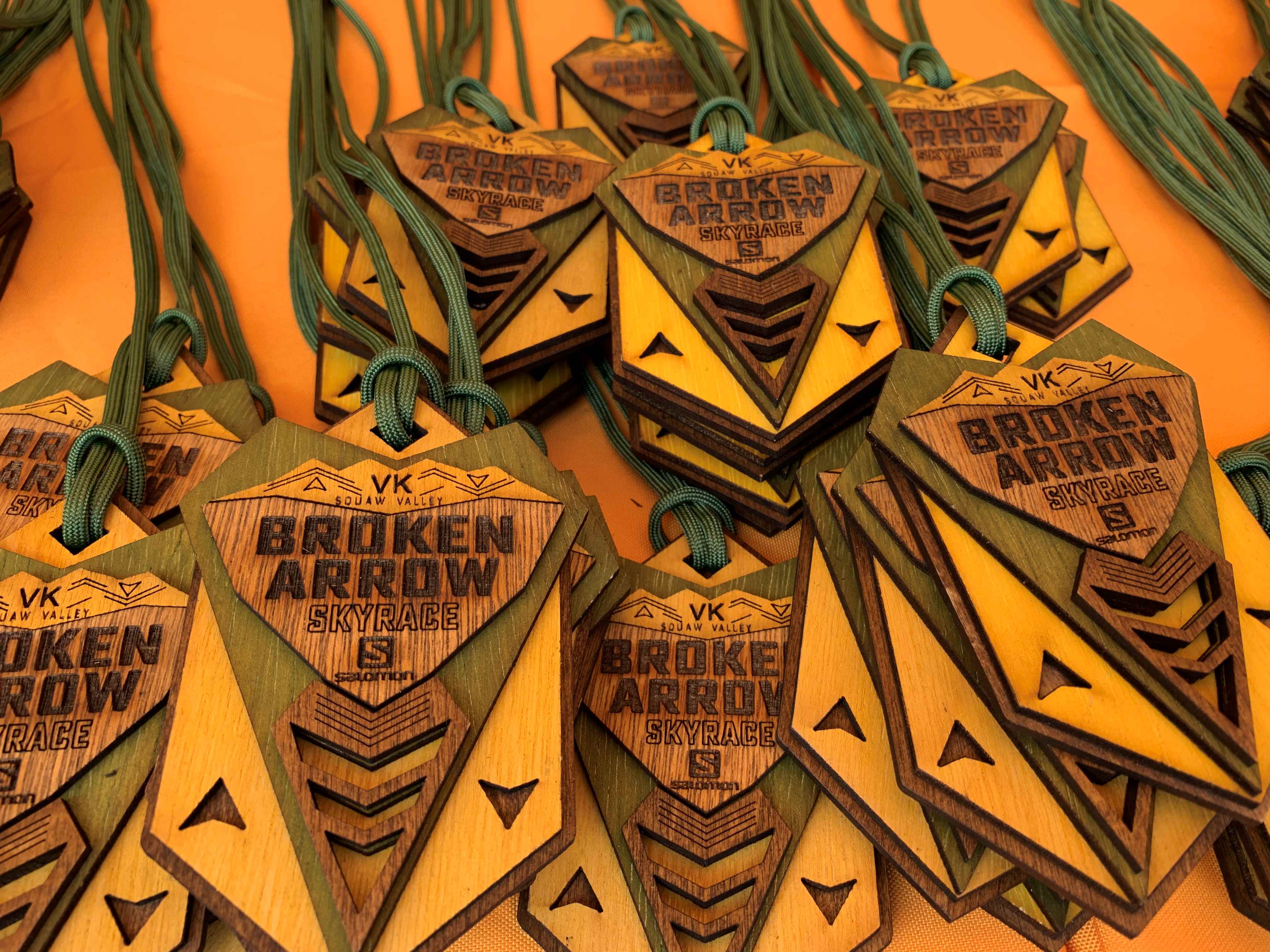
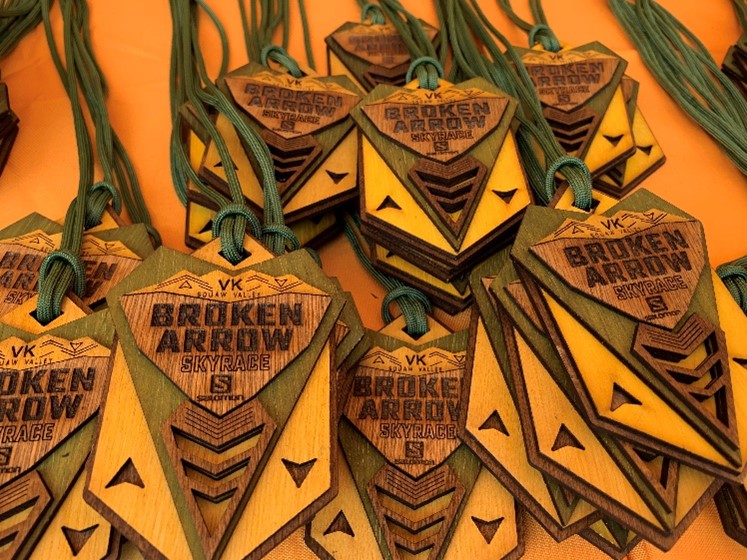
Broken Arrow medals

Get Ready For The 2023 Valsir World Cup

This weekend sees the first races in this year’s World Cup. Let’s find out what we’ve got in store over the next four months.

The 2023 Valsir World Cup has an exciting mix of races which are new to the series, as well as established favourites which attract the best athletes year after year. We are certain to see some incredible racing and discover up-and-coming runners, all under the backdrop of some of the most stunning mountain locations in the world. We continue to partner with our sponsor Valsir in order to keep growing and developing the World Cup.

 Let’s take a look at the 17 races across 11 events in 8 countries, which make up the 2023 Valsir Mountain Running World Cup.

Broken ArrowFirst up and kicking off the 2023 World Cup is Gold Label race Broken Arrow in Palisades Tahoe in the USA spanning 16th to 18th June. This race first debuted in the World Cup in 2019 and this year it will again provide a vertical uphill race (6.8km with 954m of ascent) and a long mountain race (23km/1533m).
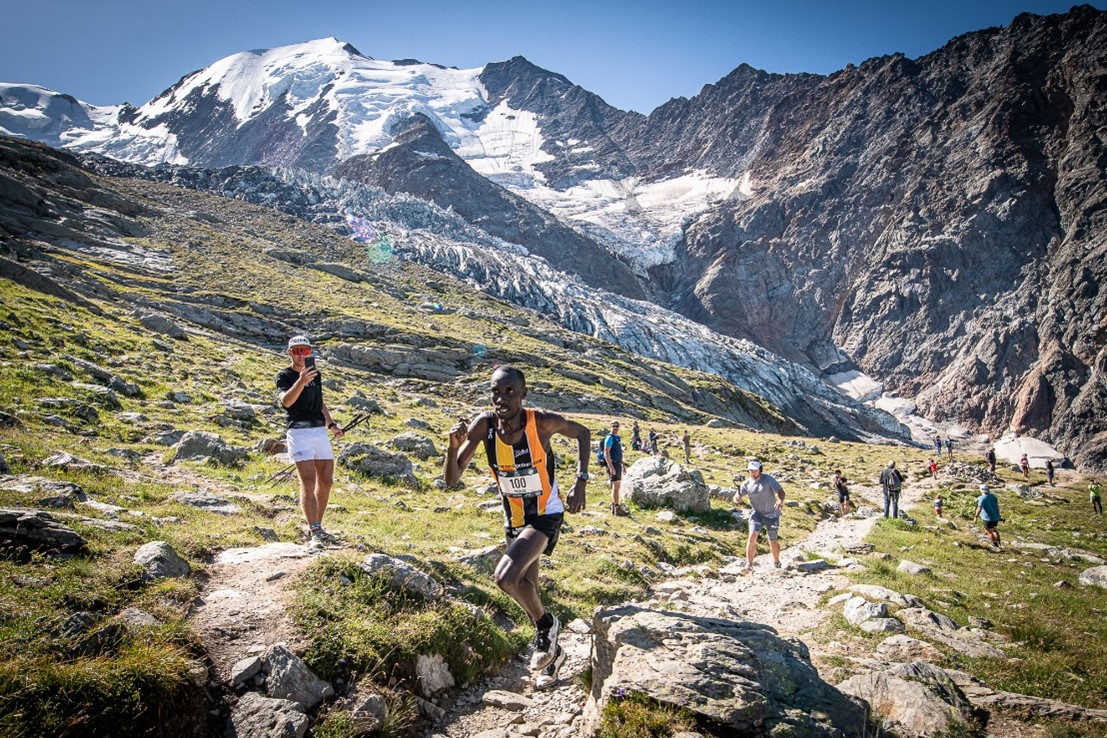
Broken Arrow describes itself as ‘European-inspired mountain running characterized by off-trail scrambling, steep terrain, and massive amounts of vertical gain and loss’ and the majority of it takes place at over 2000m. It always boasts top elite fields in both races and it’s a fitting place to begin this year’s World Cup.

From the USA we head to Zakopane in Poland for our first Silver Label race of the year at Tatra Race Run on 25th June. This is our next long mountain race over 24km with 1700m of ascent. This race made its debut in the 2021 World Cup and it takes place in in the Tatra Mountains, the highest range in the Carpathian Mountains between Poland and Slovakia.

The following weekend (2nd July) the World Cup moves on to Portugal for our next Gold Label race, Montemuro Vertical Run, a classic mountain race in Castro Daire. It’s only the 3rd edition of this event but at its World Cup debut last year it proved to be a stunning location and a fast, runnable course with 980m of ascent over 10.2km. The final steep, technical climb to the summit delivered a brutal sting in the tail with panoramic views.

After a weekend off we then roll on to our next Gold Label event, a double header in Malonno with Piz Tri Vertical on 15th July and Fletta Trail (classic mountain race) on 16th July. These races will showcase the fervency of Italian mountain running and are sure to attract a top field like they do every year.

LMNAFrom Italy we head to France for the next Gold Label race on 22nd July, La Montee Du Nid D’Aigle. This is another classic mountain race of 19.5km with 2000m of ascent, taking place in Saint Gervais Mont Blanc. The ‘climb to the eagle’s nest’ is steeped in tradition – this will be its 36th edition – and is seen as a must-do race for mountain runners. It delivered some amazing racing in the World Cup in 2021 and 2022.

After a brief summer break the World Cup returns on 12th August with arguably the most famous mountain race of all, Sierre Zinal. This year marks its 50th edition and there’s no doubt that it will attract a top field of international runners. ‘Le Course des Cinq 4000s’ is our next long mountain race at 31km with 2200m of ascent and 1100m of fast, runnable descent.

September sees some more big World Cup races. Firstly, we head to Nasego for our second Italian double header on 2nd and 3rd. On the Saturday we have the 8th Vertical Nasego, our next vertical uphill race with 1000m of ascent over just 4.1km. This race is always a classic of the mountain running calendar and provides some unforgettable images as the final section is so steep it requires hands as well as feet. The following day Trofeo Nasego provides our next long mountain race of 21km with 1330m of ascent, most of which comes in the second half. Runners have a flatter, fast first half, then they take on the steep climb to Refugio Nasego before the final descent.

The next weekend (8th to 10th September) we go to Spain for the first of two weekends of Gold Label World Cup racing this year. Canfranc-Canfranc, the race which will host the 2025 World Mountain and Trail Running Championships, will provide the setting for another vertical uphill race, with 927m of ascent over 4km, and our next classic mountain race of 16km with 1600m of positive ascent. In the vertical uphill race runners will start at Rosieta and top out at Tuca Blanca at 2400m. On the circular route of the classic mountain race runners will head to the peak of La Moleta at 2572m at the 5.8km point, then race it out over 10km downhill to the finish at Canfranc Estacion.

Next up on 30th September is a visit to Primiero in Italy for a Silver Label race making its debut in the World Cup – the Primiero Dolomiti Trail race, which is a classic mountain race, followed by another Silver Label race on 7th October at an old favourite for the World Cup, Smarna Gora Race. This will be the 44th edition of this historic race.

Finally it’s back to Spain for the Sky Gran Canaria Gold Label races on 13th to 15th October. The beautiful town of Agaete on the coast will play host to three races – a vertical uphill, classic mountain and a long mountain – which will decide the final World Cup standings for the runners.


CANFRANCPIRINEOS 2025 RECEIVES THE FLAG FROM INNSBRUCK-STUBAI 2023

The Pyrenees will succeed the Alps as the next venue to host the WMTRC in SEPTEMBER 2025. The World Mountain and Trail Running Championships which just finished at Innsbruck-Stubai.

The Mayor of Canfranc, Fernando Sánchez, received the official flag that accredits the next venue organizing the WMTRC2025.

The recently concluded World Mountain and Trail Running Championship in Innsbruck-Stubai has fulfilled the expectations regarding quantity and quality of athletes.

Bringing together in the Tirolean Alps more than 1,600 athletes from 70 countries, among which stood out real some mountain and trail running legends which added new titles to their already stunning careers, such as the Norwegian Stian Angermund,  Kenyan Patrick Kipngeno, the Austrian Andrea Mayr and Grayson Murphy from the USA.

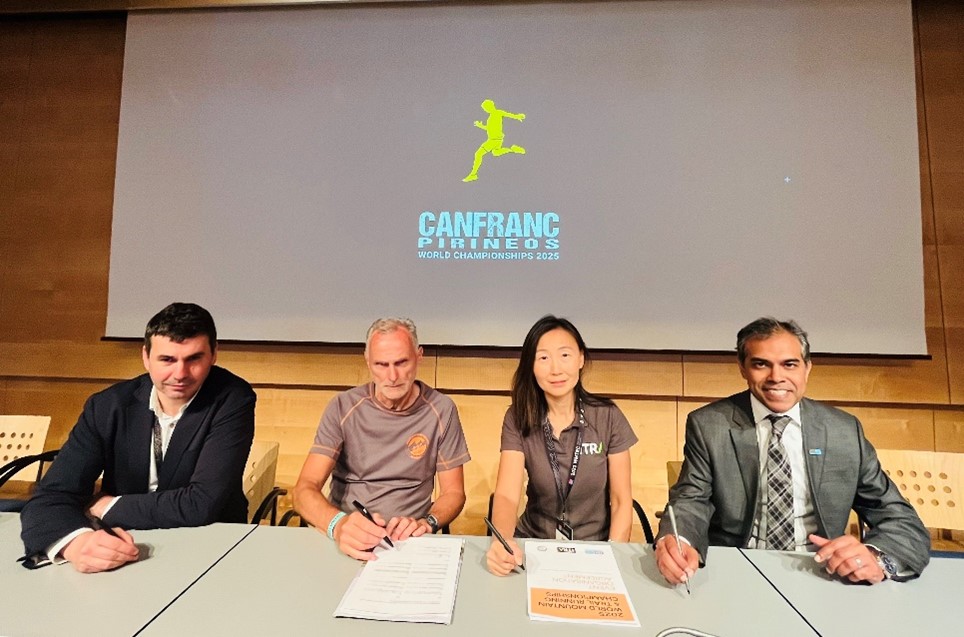
During the closing ceremony acts at Innsbruck-Stubai, the representatives of World Athletics (Alessio Punzi, Head of Running), in conjunction with the International Association Ultrarunners (IAU) President Nadeem Khan, the International Trail Running Association (ITRA) President Janet Ng, the World Mountain Running Association (WMRA) President Tomo Sarf and the Mayor of Canfranc, Fernando Sánchez, signed the contract to officialize the next CanfrancPirineos 2025 World Championships, to be held in September 2025.

Canfranc 25 2

CANFRANC PYRENEES 2025: FIVE PROPOSED MOUNTAIN RACES.

The organization of CanfrancPirineos 2025 is fully aware that technical excellence is an essential requirement to organize an international competition such as the Mountain and Trail Running World Championship. The routes have been carefully planned, taking international requirements into account, while offering the experience of running in a unique and privileged environment. Sustainable development recommendations will also be rigorously applied. The proposals for the different modalities are:

  • Junior 6k (6,2k/D+303m) A fast immersion upon the Canfranc alpine forests 
  • Uphill 4k (4,4k/D+927m) Rioseta circus and its 1.001 limestone colors.
  • Classic 12k (11,9K/D+757m) Race upon Benito Ayerbe´s legacy. 
  • Short Trail (45k/D+3910m) The course of world champions, that started it all. 
  • Long Trail 75k (75k/D+5780m).Across the Pyrenees into France and back.


Classic Race Provides Unforgettable Finale to WMTRC 2023

On the final day of racing at the World Mountain and Trail Running Championships 2023 we saw nail-biting competitions in which the two lap course provided the drama, with top positions changing constantly.

The course

On a hot day, with the temperature at 22 degrees Celsius in the city centre, the classic mountain race started and finished in Innsbruck town and it was a fast and furious course, which consisted of two laps of a loop, totalling 15km with 751m ascent. The route took the runners across the Inn on the Europaratsallee and to the trails on the Nordkette, climbing steeply up to Gramartboden, then heading through the forest to top out at 937m. There then followed a long descent on steep, tree root-covered trails, then hard trail back to the city, heading via the famous Höttinger Gasse to the old town. The final flat section on road at the end gave a good opportunity for exciting sprint finishes.  

The men’s race

Patrick Kipngeno (KEN), the winner of this year’s uphill race was back to see if he could do the double. But it was going to be a big ask for him, given the strength and depth of the field assembled.  

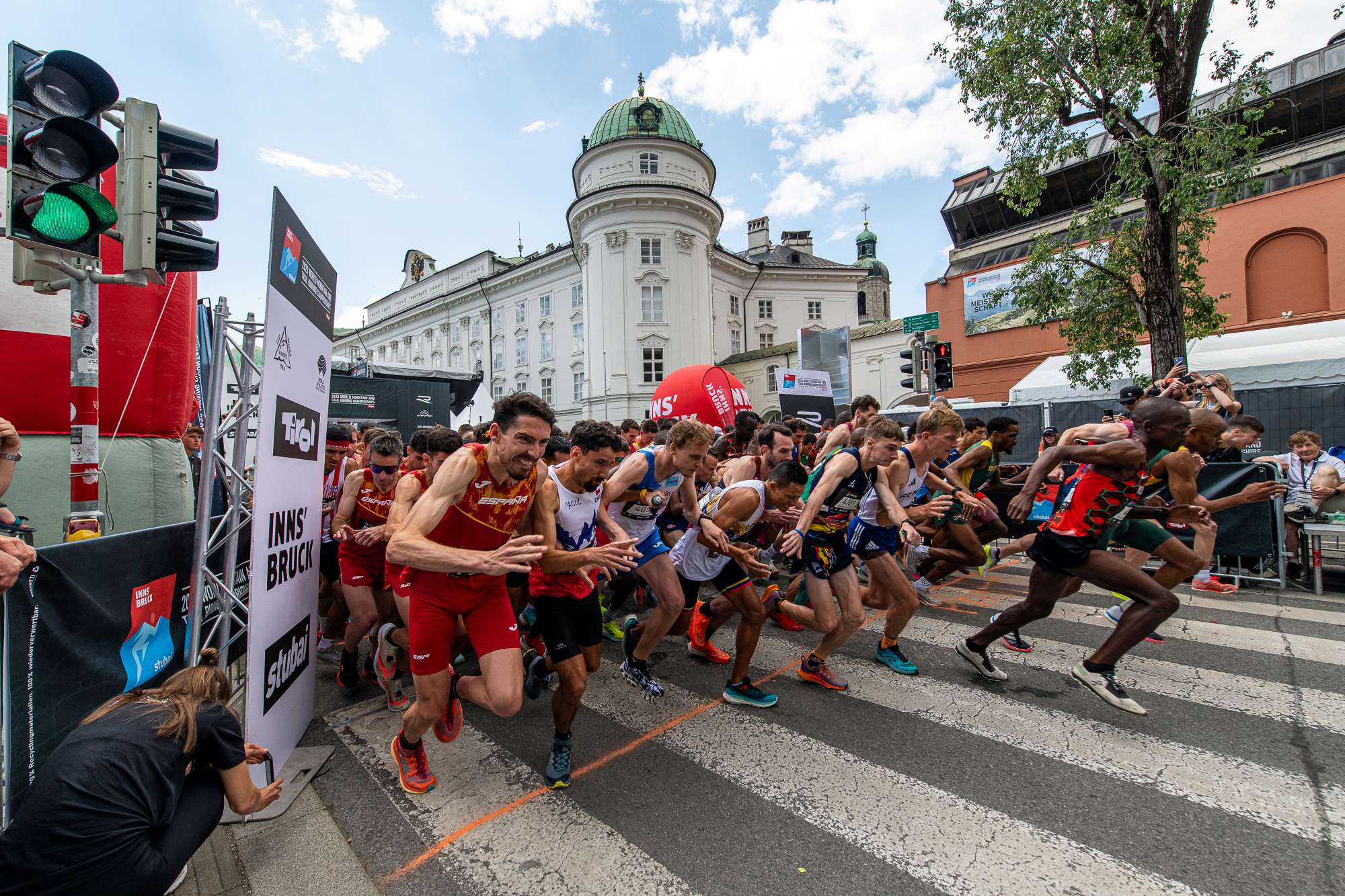
 DSC8278From the start it was Isaac Mande Kibet (UGA) who took it out. Initially he was followed by Liam Meirow (USA) and it all remained very close together, with Ombago Kiriago Philemon (KEN) and Filimon Abraham (GER) at the front of the pack. As they started the uphill section through the woods it was narrow singletrack which offered few opportunities to overtake, but once they started the first of the two long downhills back towards the city it all started to shake out in a big way.
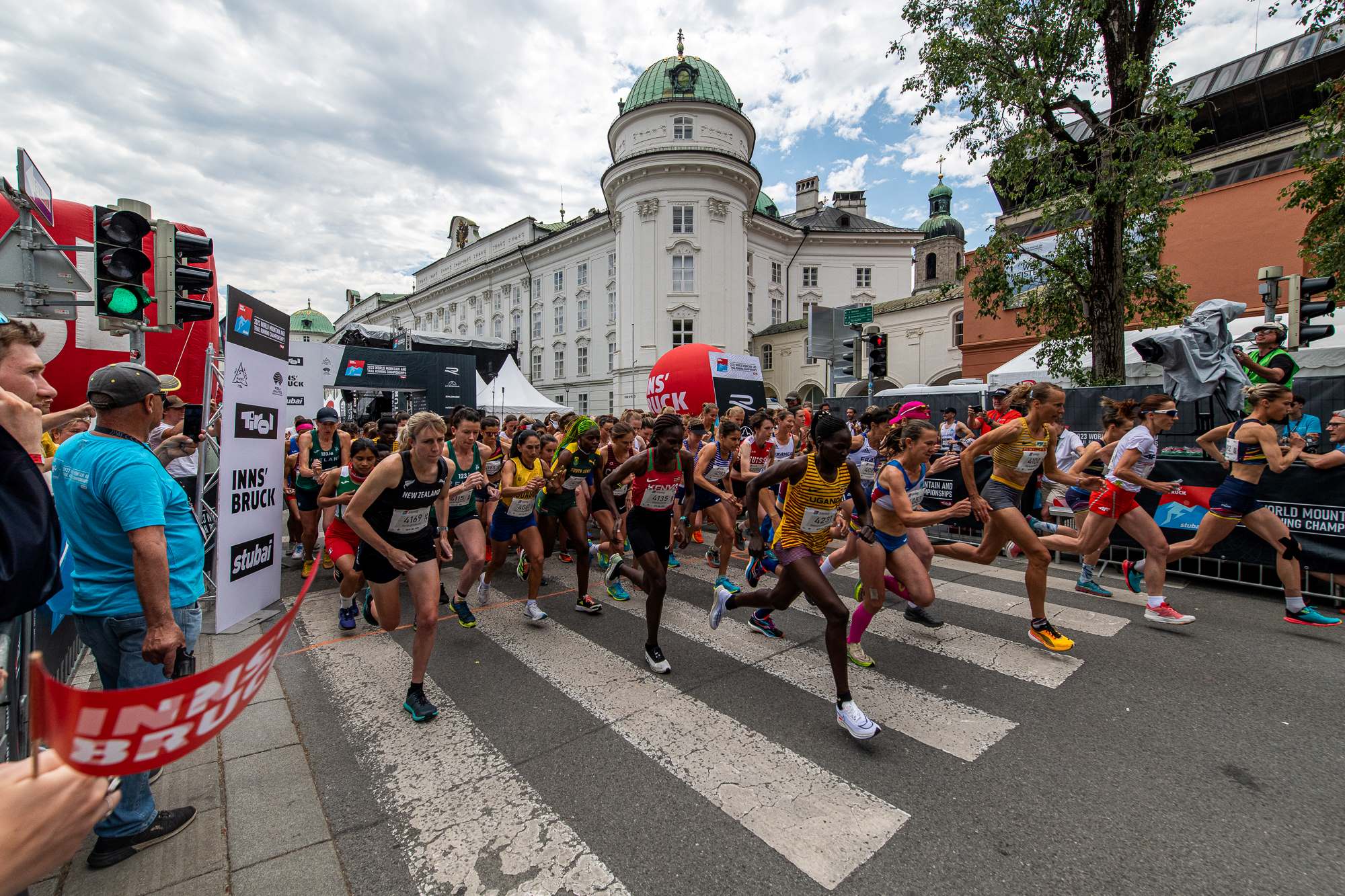
At the 5k point it was Abraham who popped out into town first, very closely followed by Philemon and Cherop. As they ran into town it looked very much like a fast road race (including the runners’ shoes, which were mostly ‘supershoes’) and Cherop pulled away, almost as if he was going to finish at the end of this first lap. Perhaps confused, he then dropped back quickly as the second lap began.

In what was to be a theme of the day the second lap was almost a different race to the first lap. The two lap format, combined with the different skillsets of uphill and downhill runners meant that no runner could take anything for granted. The sands were constantly shifting.

Abraham and Philemon then hit the front again as they headed uphill at an incredible pace, with the lead changing hands several times. Philemon pulled away once they hit the traverse at the top of the climb, but Abraham and Leonard Chemutai (UGA) were still chasing hard, followed by a pack of runners slightly behind, which included Kipngeno and Cesare Maestri (ITA).

Philemon had a small lead over Chemutai as they began the final long downhill towards the town, and Abraham was still in contention. There was then a small gap back to Kipngeno and Cherop. As they approached the final few kilometres Chemutai made his move and tried to open up a gap on the final section of downhill. Would this be the decisive move?

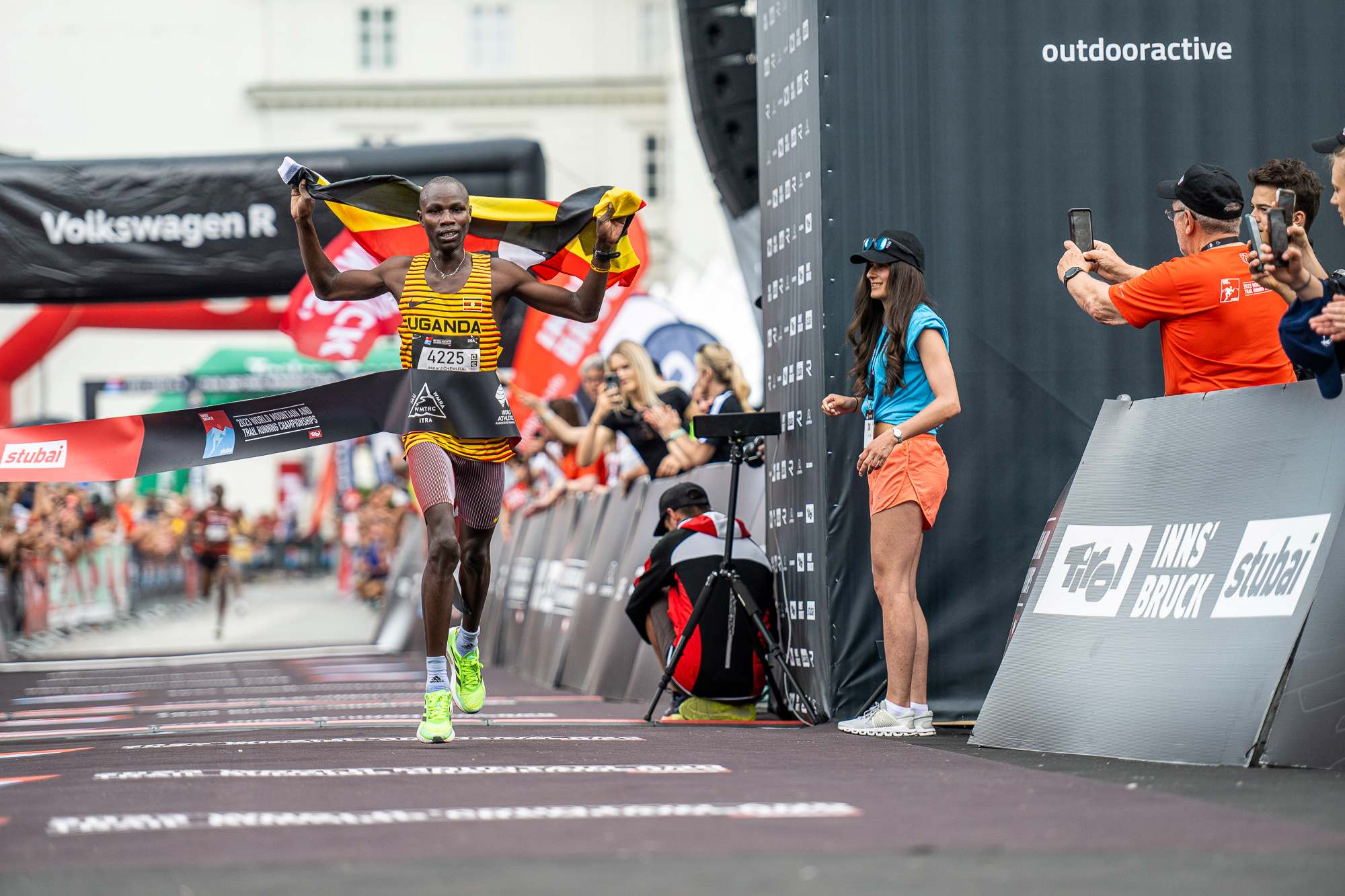
Chemutai did manage to hold onto the small gap and take the victory to become World Champion in 56.14. Philemon maintained second place in 56.22 and Abraham took the bronze in 56.27. DSC2073

The second lap served to shake up the minor places so much that the team competition became an exciting race in itself. While Kenya were clear winners of team gold it was strong second laps from Italian and in particular Spanish runners that won the team silver and bronze.

Men’s top 5

  1. Leonard Chemutai (UGA) 56.14
  2. Ombogo Kiriago Philemon (KEN) 56.22
  3. Filimon Abraham (GER) 56.27
  4. Eliud Cherop (UGA) 57.26
  5. Patrick Kipngeno (KEN) 57.27

Men’s team competition

  1. Kenya (15 points)
  2. Italy (30 points)
  3. Spain (43 points)

The women’s race

The heat had risen even more for the women’s race, but Grayson Murphy (USA) led the race out, looking extremely cool and composed. A small pack quickly formed behind her on the first uphill, consisting of Monica Madalina Florea (ROU), Valentine Jepkoech Rutto (KEN) and Joyce Muthoni (KEN). Murphy seemed to be calmly opening a small gap as they headed up through the tree-lined singletrack. Given her 5km pace on the flat, this must have been a worry for those following her. DSC8294

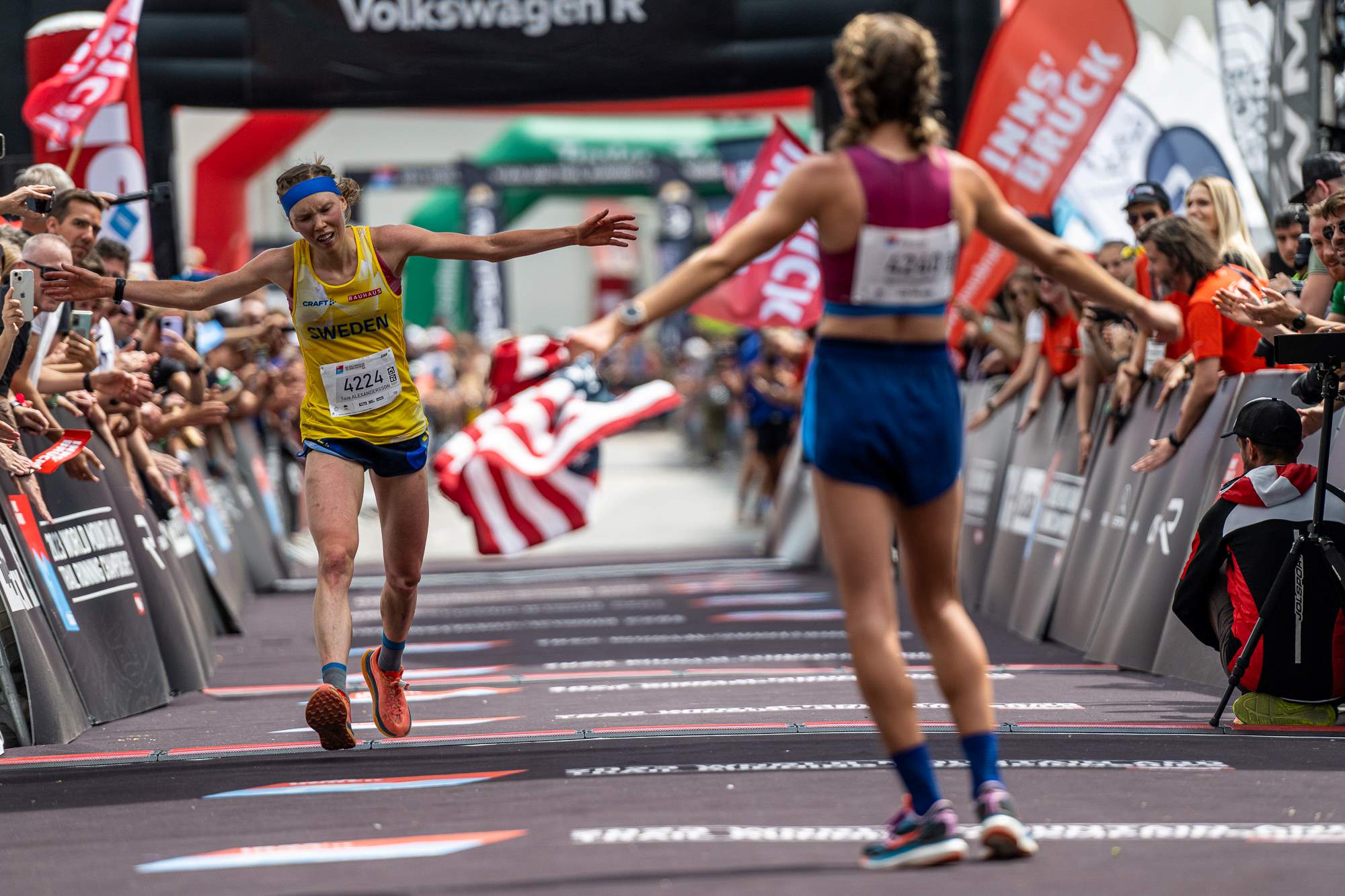
Once they made the first transition from the uphill to the down on the first lap, Murphy still had a small gap but it was Tove Alexandersson (SWE), the multiple orienteering world champion, who was making up the ground on the downhill and she was now in second. Rutto, Philaries Jeruto Kisang (KEN) and Muthoni led the chase, with Annet Chemengich Chelangat (UGA) and Florea close behind them.

Alexandersson then made a move on the final bit of downhill as they came down towards the approach to the town. Murphy kept in touch with her but the gap opened to 9 seconds as they hit the road. At this point Muthoni was 18 seconds behind Murphy in third. The second lap was already looking like it was going to be very interesting.

Just as in the men’s race lap two almost served as a reset, saying ‘ok, let’s go again’. And just as in the men’s race there were lots of changes in positions, setting up an exciting team competition.

Unexpectedly Alexandersson continued to pull away on the road section through town, but the minute the road started to kick up again Murphy quickly caught and passed her. Murphy now needed to open up a big gap, now that she had seen what a danger Alexandersson is on the downhill. Murphy kept her metronomic pace on the uphill, still looking very calm.

Once Murphy hit the short road section towards the top of the uphill she immediately pushed the pace. At this point Alexandersson was 25 seconds behind, with Chelangat 20 seconds behind her. On the first lap this hadn’t proven a barrier for Alexandersson. Would she come back to Murphy on the downhill again? Muthoni and Rutto were also still in contention. Once they started the final, decisive, long downhill we would have a very exciting finish on our hands.

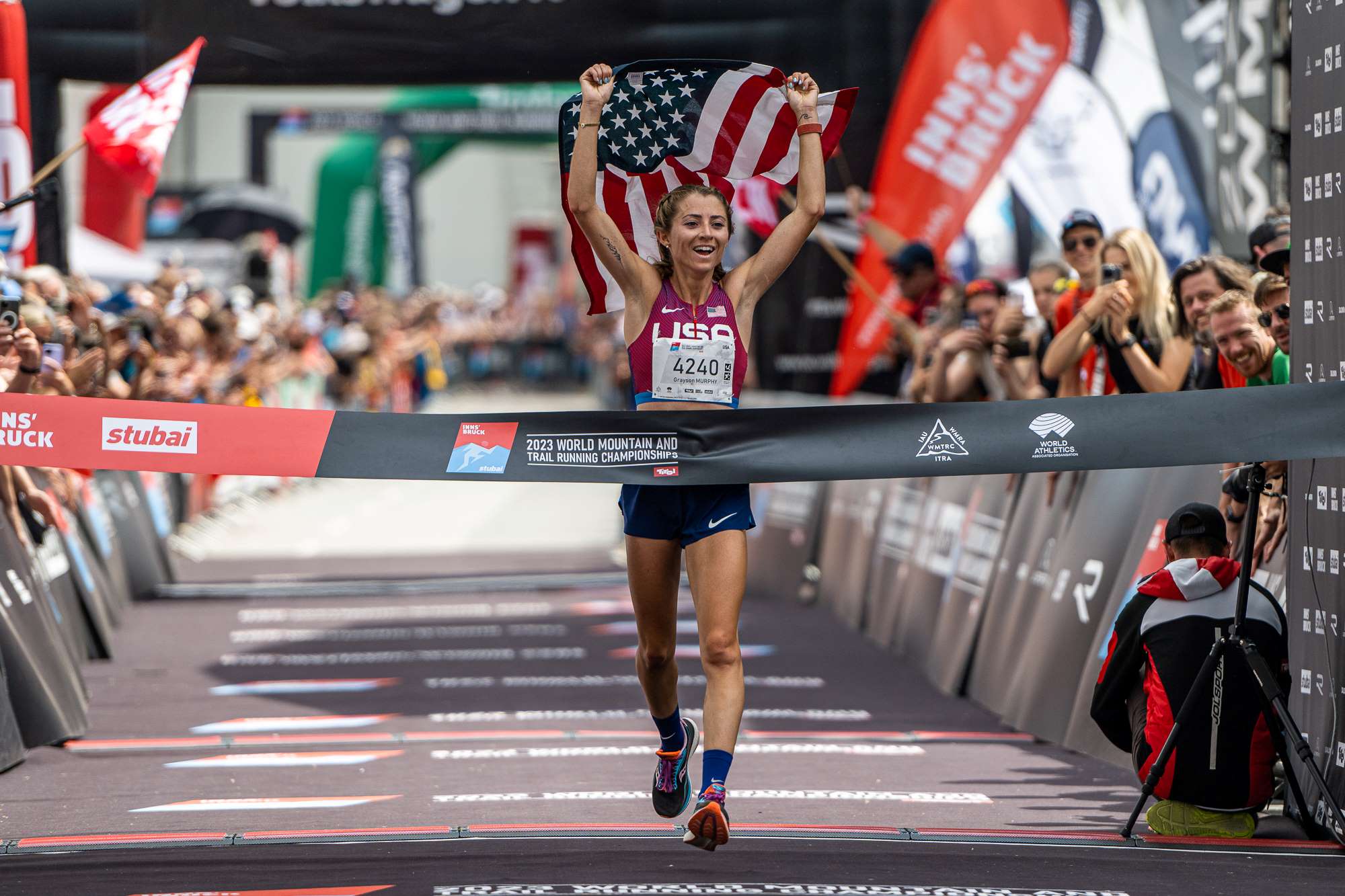
At the 10.5km point Murphy held a lead of 50 seconds over Alexandersson, who herself was neck and neck with Chelangat. The race now seemed to be for silver and bronze. Eventually Murphy didn’t let up at all and maintained her lead to become World Champion in 1.04.29. Alexandersson took the silver in 1.05.26 and it was in fact Muthoni who took the bronze in 1.06.40 after it seemed that Chelangat injured herself on the downhill, or was suffering, as were many others, in the heat. DSC2582

Just as in the men’s race, the team competition had a clear winner in Kenya, but it came down to the minor positions for silver (Great Britain) and bronze (France), proving how important it is for runners to fight for every place.

Women’s top 5

  1. Grayson Murphy (USA) 1.04.29
  2. Tove Alexandersson (SWE) 1.05.26
  3. Joyce Muthoni (KEN) 1.06.40
  4. Valentine Jepkoech Rutto (KEN) 1.06.56
  5. Domenika Mayer (GER) 1.07.09

Women’s team competition

  1. Kenya (14 points)
  2. Great Britain (43 points)
  3. France (46 points)

The women’s race brought the curtain down on an unforgettable World Championships. The heat clearly played its part today, with several athletes needing medical attention at the finish line, but the course delivered four incredibly exciting races, with the top positions changing depending on where the runners were on the route.

Junior Runners Deliver Exciting Start to Final Day of WMTRC 2023

Victories for Uganda and Great Britain in exciting Junior Classic Mountain races, to kick off the final day of the World Mountain and Trail Running Championships 2023.

The course

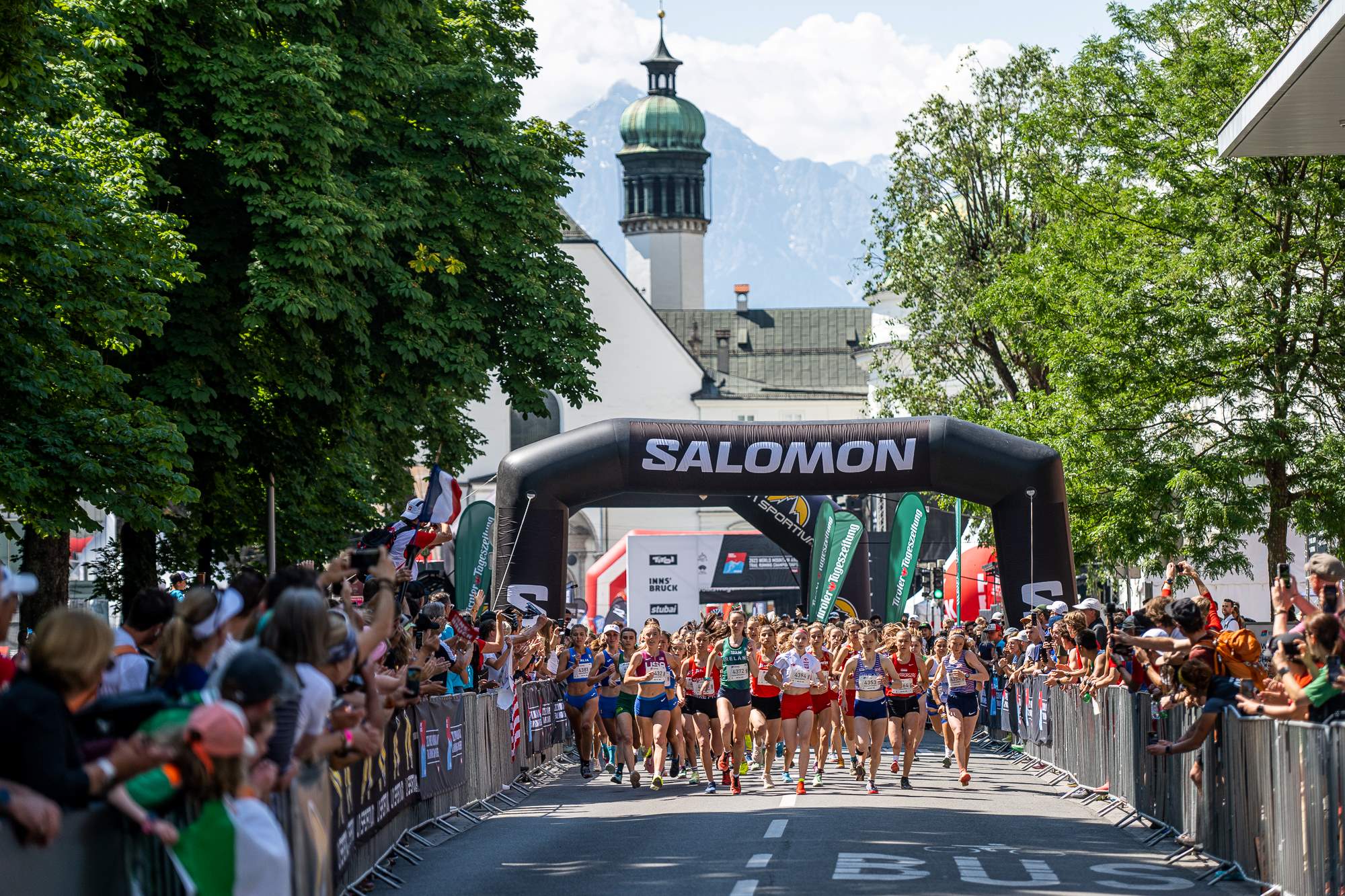
The classic junior race started and finished in Innsbruck town and it was a fast and furious course. The route took the runners across the Inn on the Europaratsallee and to the trails on the Nordkette, climbing steeply up to Gramartboden, then heading through the forest to top out at 937m. There then followed a long descent on steep, tree root-covered trails back to the city, heading via the famous Höttinger Gasse to the old town. The final kilometre on road gave a good opportunity for the spectators to see what the runners had left in their legs.

The route consisted of one lap of a 7.4km loop, with 374m of ascent. The junior runners are athletes who are not yet 20 years of age in the year of competition.

The men’s race

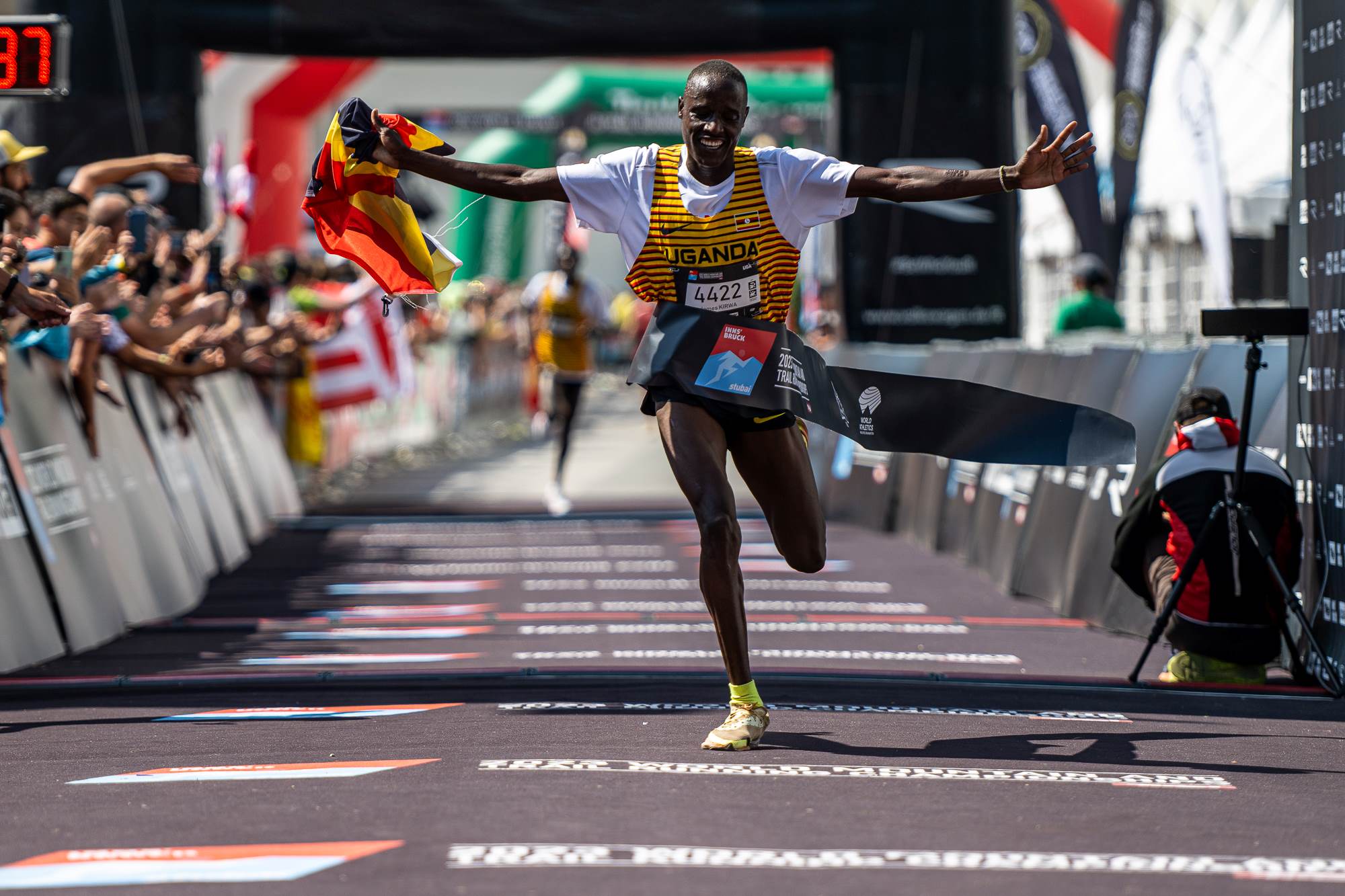
It was Hosea Chemutai (UGA) who led the fast pace from the start. Fellow countryman James Kirwa was with him and Lukas Ehrle (GER) and Mervan Haykir (TUR) completed the initial leading pack.

At the 3.7km point we saw how the long climb had shaken up the leading pack and it was Kirwa who had taken the lead, but Chemutai was still with him and Matthieu B?hrer (SUI) had now joined them. Ehrle was still in contention, just 10 seconds back.

But who would emerge from the long, fast downhill first, and would they be able to hang on on that last kilometre through the streets? It was Kirwa who hit the town first, but Chemutai was right behind him. After an exciting sprint through the streets, lined with spectators, Kirwa held him off to become World Champion! Chemutai took the silver, just 6 seconds back, and B?hrer the bronze.

 DSC1158

Men’s top 5

  1. James Kirwa (UGA) 27.37
  2. Hosea Chemutai (UGA) 27.43
  3. Matthieu B?hrer (SUI) 27.52
  4. Lukas Ehrle (GER) 28.28
  5. Jan Torrella (ESP) 28.38

Men’s team competition

  1. Switzerland (18 points)
  2. France (28 points)
  3. Spain (32 points)

The women’s race

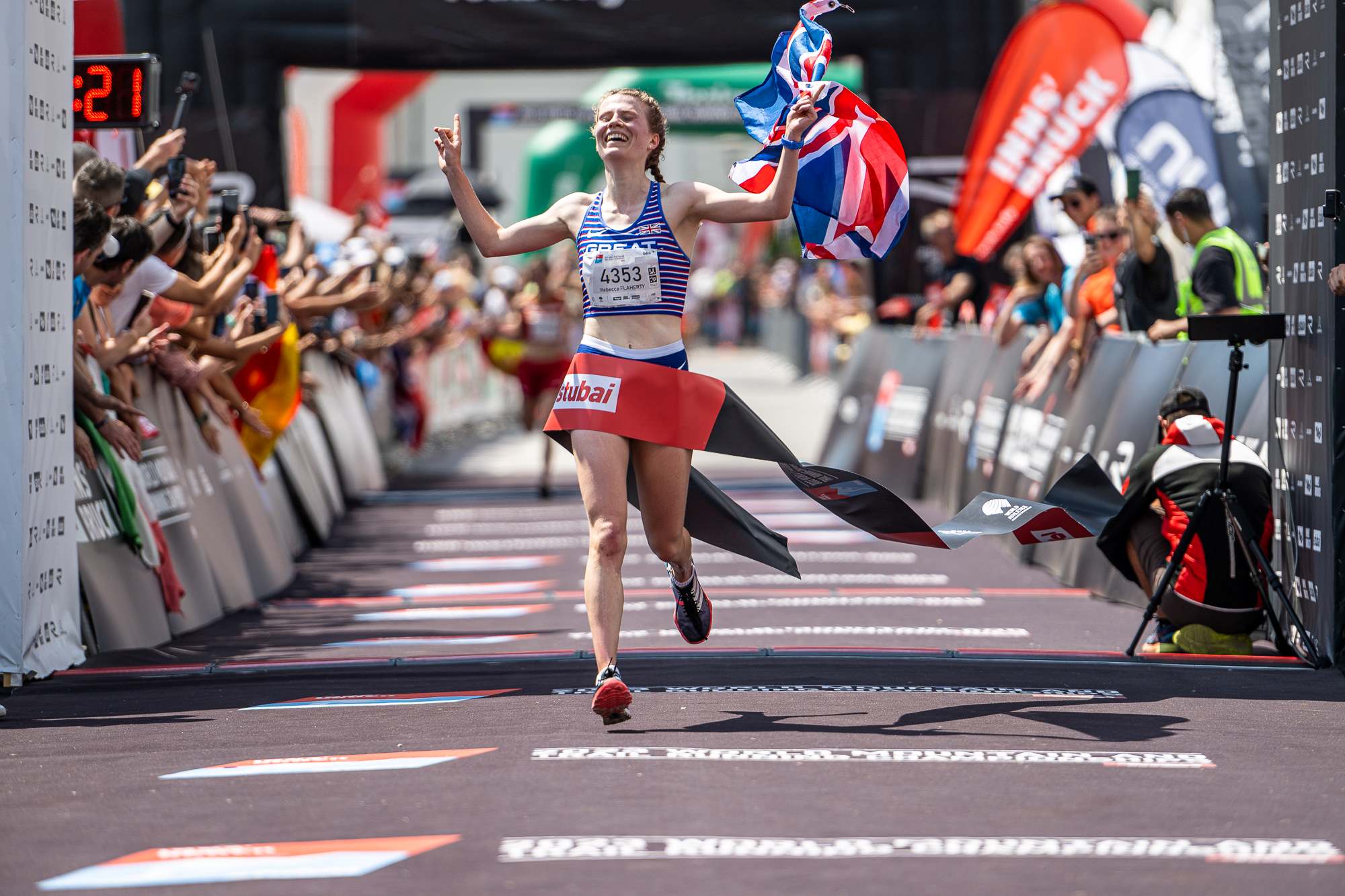
The men’s race had shown what a fast course this was going to be and the women straight away indicated that they too were going to test the camera runners. After a frantic first 500m it was Rebecca Flaherty (GBR) who took on the race. At the 1.6km point, with a good chunk of the climb done it was GBR in 1, 2 and 3, with Amelie Lane and Eve Whitaker just behind.

But Ines Herault (ESP), Lucia Arnoldo (ITA) and Lauren Russell (GBR) were all close by and at the 2.4km point it was Flaherty in the lead with a 38 second buffer from Russell and Herault, Arnoldo and Lane a few seconds back. But Flaherty had managed to stretch out the lead to 45 seconds by the 3.7km point.

It was all going to come down to the downhill and the frantic final section of concrete. Flaherty popped out into the town leading, but Arnoldo and Herault were hot on her heels, trying to chase her down. It was all set up for an exciting sprint finish. In the end Flaherty was able to hold off the challenge from Herault, taking the win by 7 seconds. Arnoldo took the bronze 15 seconds behind Herault.

 DSC1398

Women’s top 5

  1. Rebecca Flaherty (GBR) 33.20
  2. Ines Herault (ESP) 33.27
  3. Lucia Arnoldo (ITA) 33.42
  4. Amelie Lane (GBR) 34.22
  5. Lauren Russell (GBR) 34.25

Women’s team competition

  1. Great Britain (10 points)
  2. France (27 points)
  3. Spain (27 points)


Fairytale start to 2023 World Mountain and Trail Running Championships

Today (7th June) at 1pm CET the World Mountain and Trail Running Championships got off to a thrilling start with the uphill race. Competitors from 70 countries toed the start line to vie for the title of World Champion.

The course

The runners took on a tough course of 7.1km with 1020m of ascent. With the temperature at 20 – 22 degrees centigrade on the course, this wasn’t too problematic in itself but with almost no wind heat was going to be a factor in the more exposed parts of the route.

After a 900m circuit of the village of Neustift in Stubai at the start (at around 988m in altitude), the route then headed quickly uphill on narrow, steep forest switchbacks. There was then a brief respite for runners after the lungbusting first 4km where the route passed Autenalm at 1665m and then traversed a short, flatter section across the mountain. But this faster section was short-lived as the course then kicked steeply upwards again from the Panoramabahn Elfer top station towards the Elferhütte. For the final sting in the tail the route headed directly onto a ski slope, where the runners had to scale a cruel 220m of ascent in just 700m of distance.

The men’s race

Last year’s uphill winner, Patrick Kipngeno (KEN), was back to defend his crown. But with such a strong field, including the silver and bronze medal winners from the last World Championships, Ombago Kiriago Philemon (KEN) and Alejandro Garcia (ESP), as well as a host of others expected to contest the podium, it was predicted to be a close and exciting race.

It was Kiriago Philemon who took the race out from the start, with Kipngeno keeping it cool and leading the chase. The area of steep, narrow switchbacks really served to stretch the runners out, despite the lack of opportunities to overtake. Once the runners emerged from this long section at Autenalm (3.9km) it was Kipngeno who was in the lead, posting a split of 25.27, with Levi Kiprotich 29 seconds behind and Josphat Kiprotich 14 seconds behind him. How would the flat section and the the final, brutal uphill shake up the field?

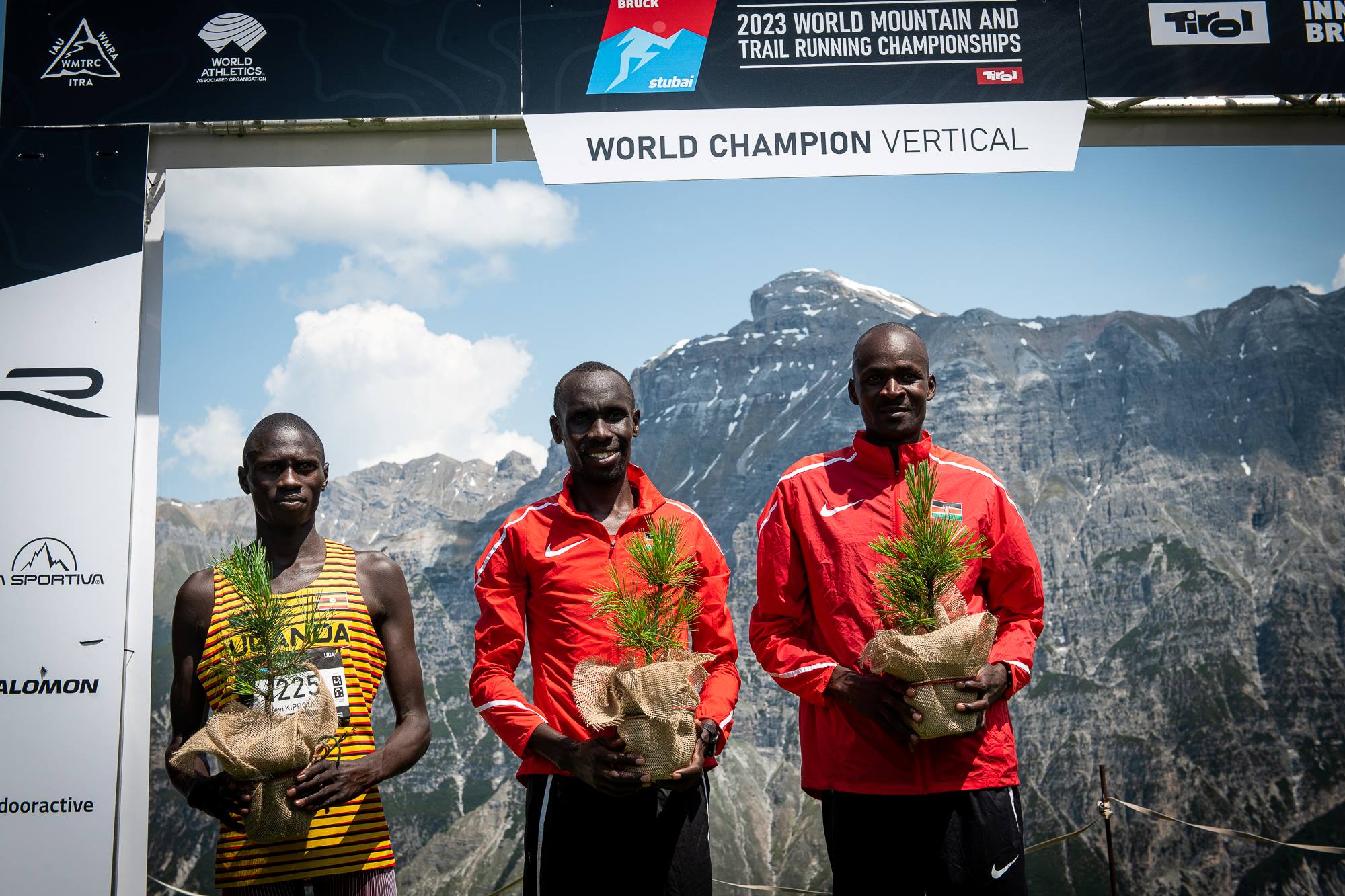
In the end it was Kipngeno who stretched out his lead to win in 40.18, with a cool dominance we’ve seen so often at in the World Cup events. Levi Kiprotich was second in 41.50 and Josphat Kiprotich third in 42.04. Team gold went to Kenya, who had three runners in the top 10 (1st, 3rd, 7th), silver to Uganda (2nd, 4th, 15th) and bronze to Switzerland (10th, 11th, 24th).

uphill men podium Marco Gulberti

Men’s top 5

  1. Patrick Kipngeno (KEN) 40.18
  2. Levi Kiprotich (UGA) 41.50
  3. Josphat Kiprotich (KEN) 42.04
  4. Eliud Cherop (UGA) 42.16
  5. Joseph Gray (USA) 32

Men’s team competition

  1. Kenya (11 points)
  2. Uganda (21 points)
  3. Switzerland (45 points)

The women’s race

Allie McLaughlin (USA) was also back as defending champion and facing an incredibly strong field, including last year’s second placed runner, the legendary Andrea Mayr (AUT). McLaughlin hit it hard right from the start and Joyce Muthoni (KEN) went with her. In what was an exciting first couple of kilometres the lead changed hands several times. Grayson Murphy (USA) joined the group, then Andrea Mayr (AUT) appeared and the race was on.

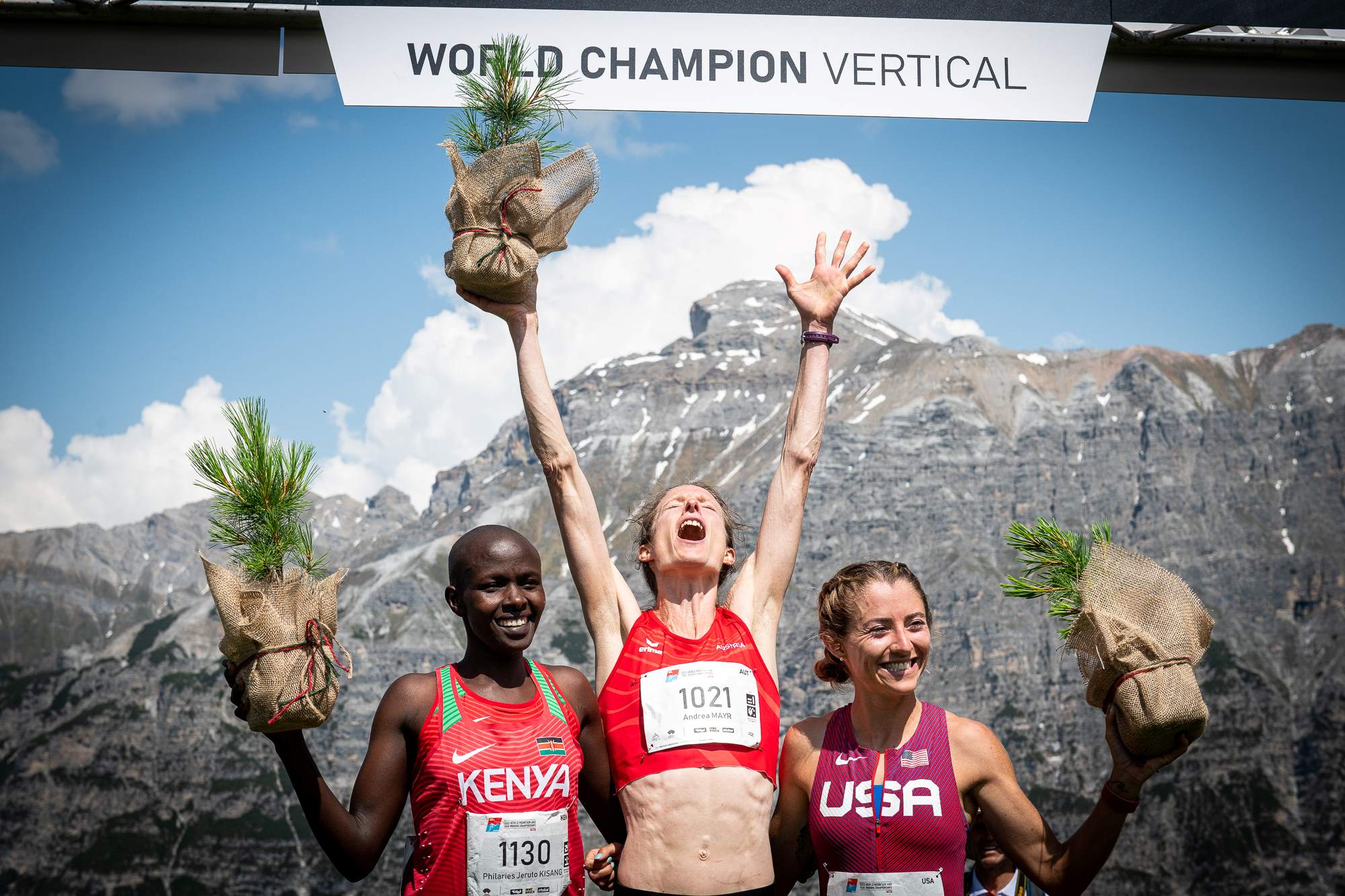
On the narrow section through the trees McLaughlin dropped back a little and suddenly Mayr made her move and quickly took a decisive lead. Could there be a fairytale 7th World title for the 43 year-old Mayr on her home turf? Valentine Jepkoech Rutto (KEN) and Philaries Jeruto Kisang (KEN) were hot on her heels, as was Murphy.

At Autenalm it was Mayr in the lead with a split of 30.08, with Kisang 33 seconds behind and Murphy 19 seconds behind her. Would the fast, flat section offer the opportunity for runners to challenge the lead, before the final climb?

Kisang took the lead just before the final climb and it looked like the dream was over for Mayr, as Kisang proceeded to open a gap. But Mayr never lost touch with her and as they hit the steep last few hundred metres she started to reel her in. As the commentator put it, it seemed as though the home crowd were collectively pushing Mayr to the finish. Once she took the lead again Kisang was reduced to a walk and there was no doubt that the title was Mayr’s. She stretched the gap out further, and Kisang had nothing left.

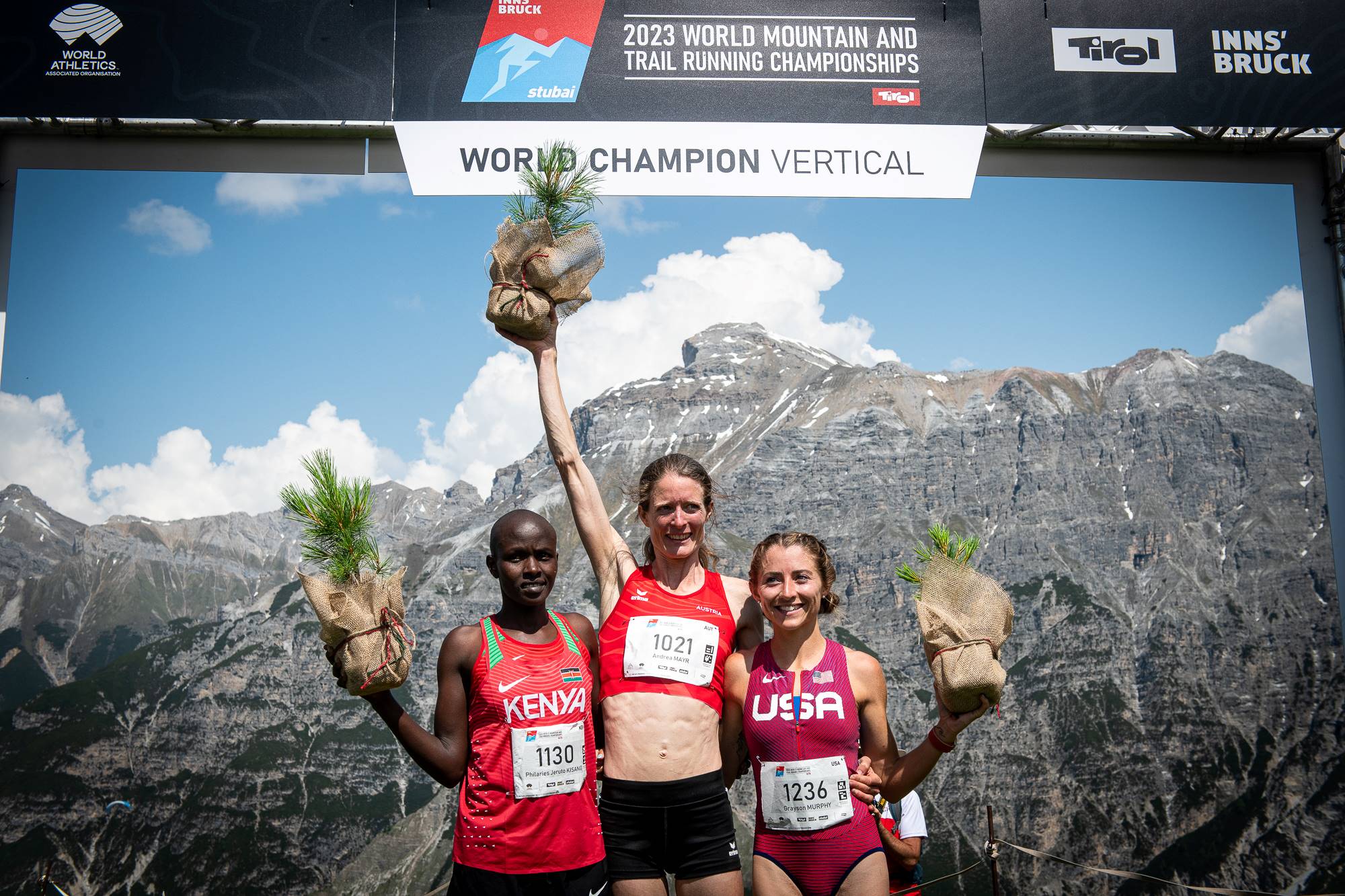
Mayr won her seventh world title in 48.14. Kisang maintained her second place in 48.51 and Murphy was third in 49.22. What an incredible start to the championships! Kenya took the gold medal in the team competition, with three runners inside the top 10. Germany took silver (with 4th, 7th and 22nd place) and Great Britain bronze (with 8th, 20th and 22nd).

uphill women podium Marco Gulberti

Women’s top 5

  1. Andrea Mayr (AUT) 48.14
  2. Philaries Jeruto Kisang (KEN) 48.51
  3. Grayson Murphy (USA) 49.22
  4. Laura Hottenrott (GER) 49.56
  5. Valentine Jepkoech Rutto (KEN) 49.59

Women’s team competition

  1. Kenya (17 points)
  2. Germany (33 points)
  3. Great Britain (51 points)